 Polina Cupcea
Behind the wheel of a tiny red Citroën with a personalized license plate reading “EVREI,” from which the techno track „We Never Return” blares out into the streets, he often zips through the streets of Odessa at rocket speed. His name is Denis Chernenko, and he is one of the most popular veterans of the Russian-Ukrainian war in this Black Sea coastal city.
He was sent to a field in the Zaporizhzhia region to defend a position that the soldiers had nicknamed “New York.” He was supposed to keep it up for four days. He stayed there for 11 days—11 days that cost him both legs but also resulted in a slight advance of the front line in Ukraine’s favour.
What followed were months in the hospital, dozens of surgeries, and trips from one doctor to another. But somewhere between that open field and the hospital ward, Denis made a vow to himself. A vow that would change not only the rest of his life, but also the lives of other veterans.
***
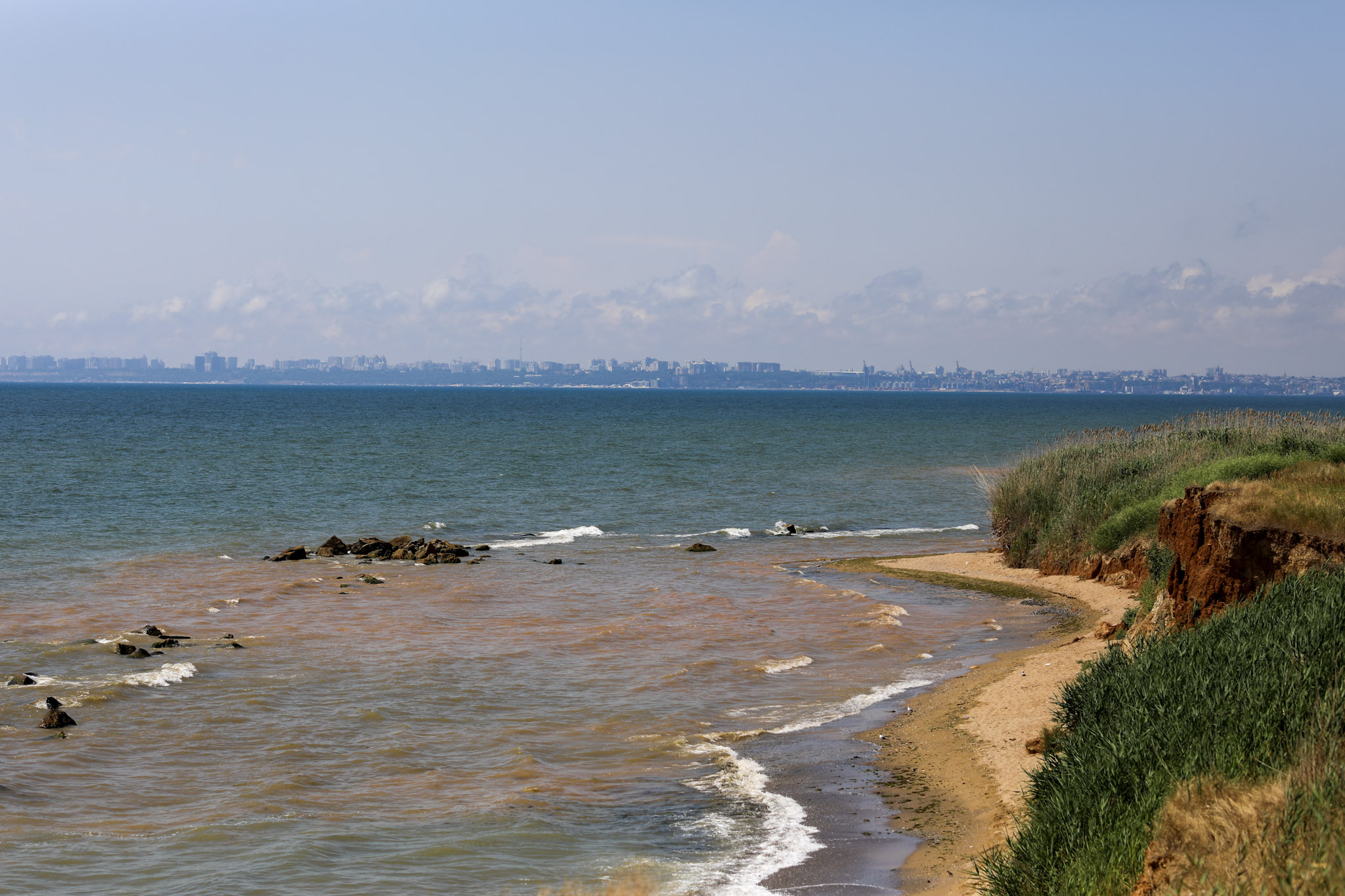
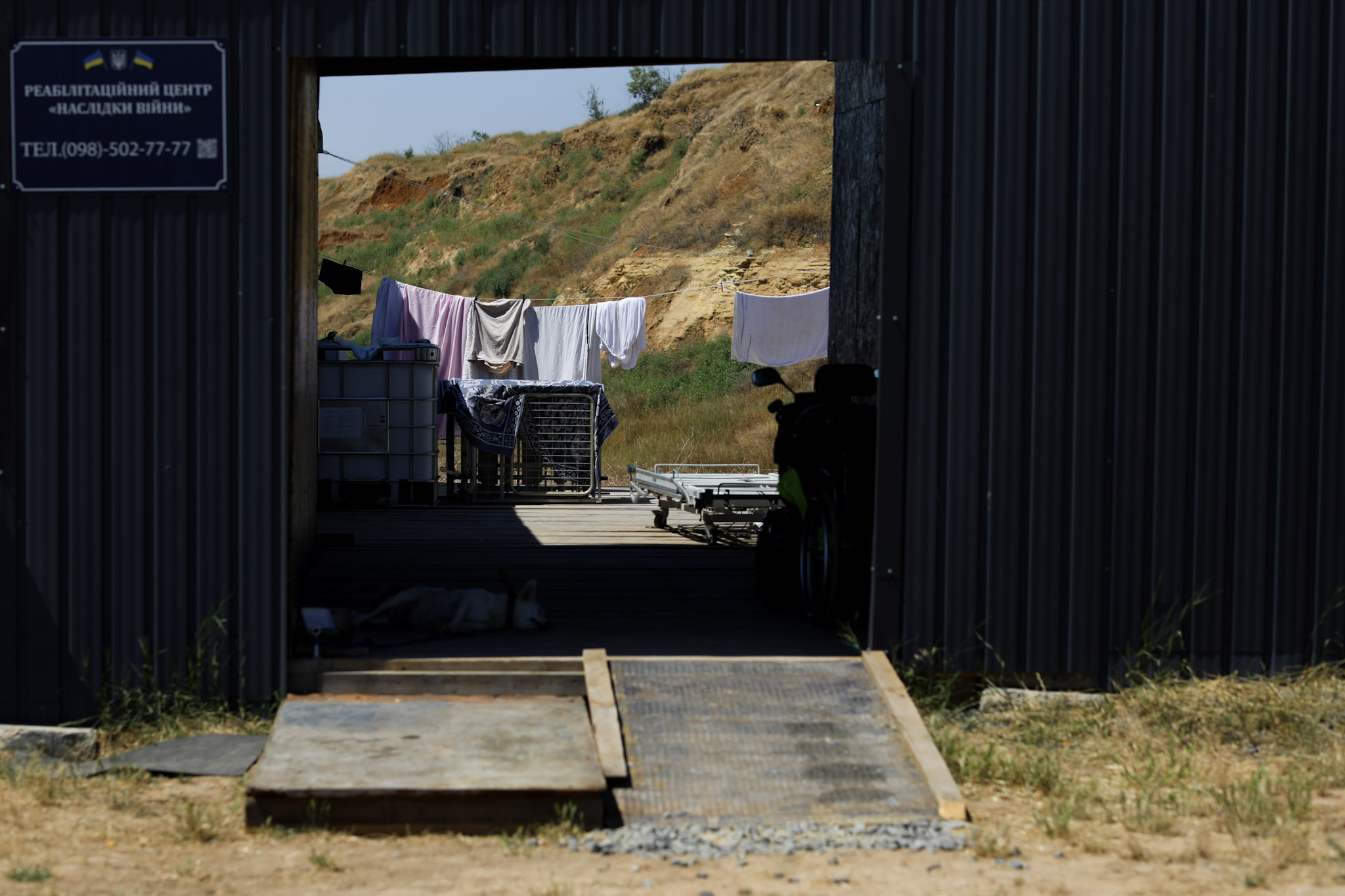
In Fontanka, a village less than 20 kilometres from the centre of Odessa, the shore rises above the sea as a low, clayey promontory with a straight, flat crest. On this plateau, between the azure sky and the turquoise water, dozens of metal containers are scattered about. Some are set to be converted into cottages, while others are already habitable. Their location marks the boundaries of the future “Consequences of War” Rehabilitation Centre,” a place of refuge for soldiers returning from the front and their families.
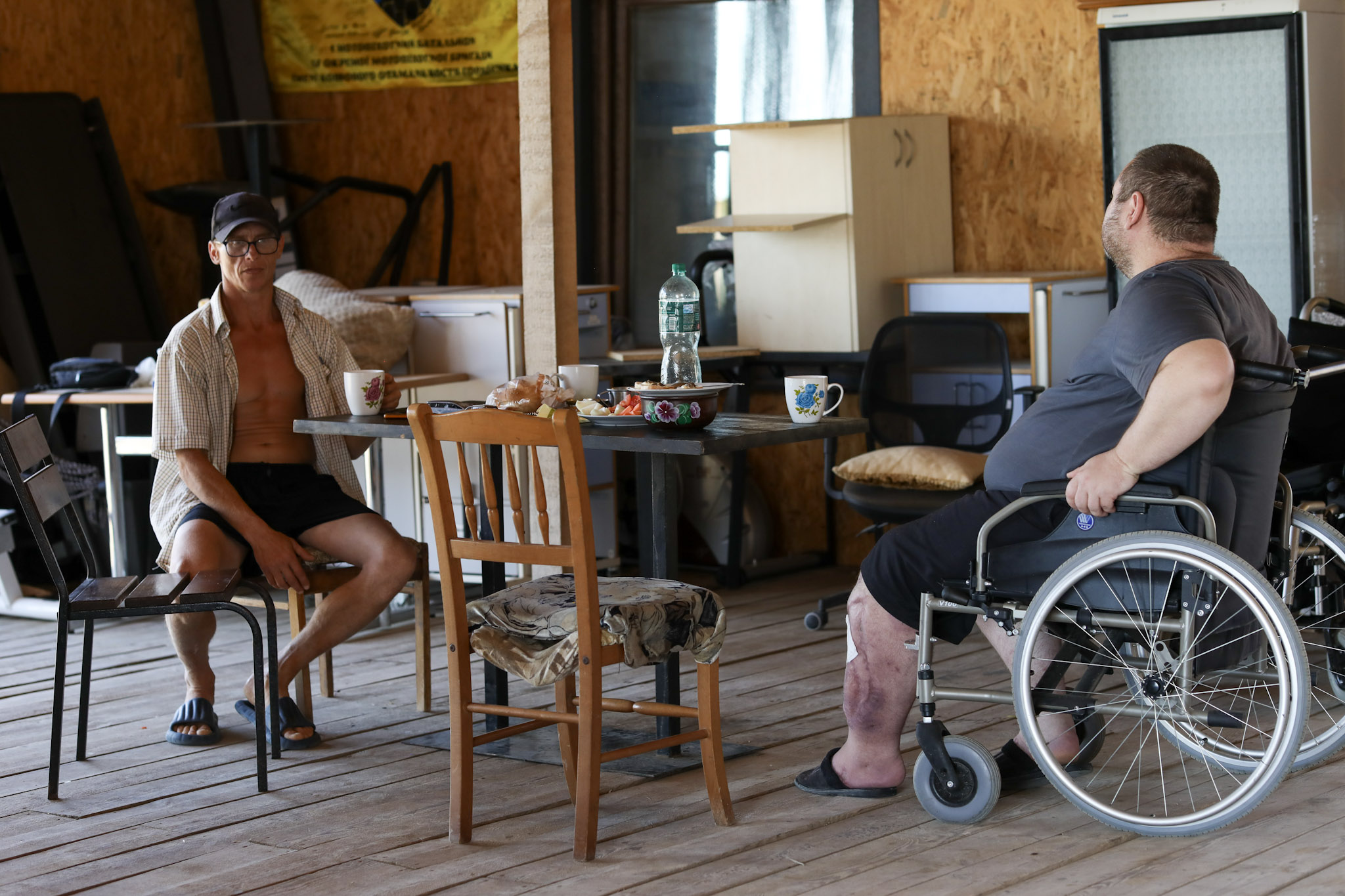
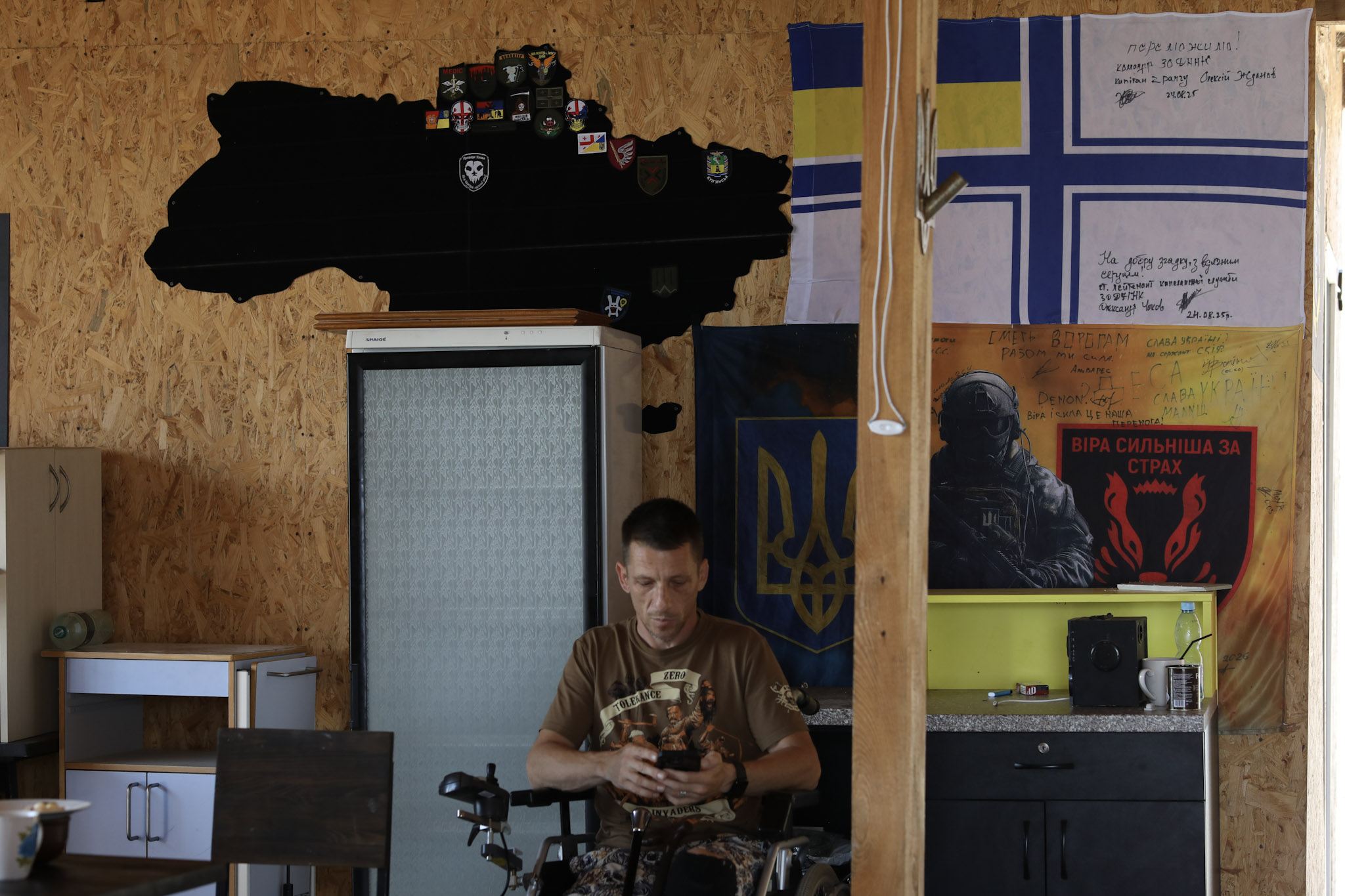
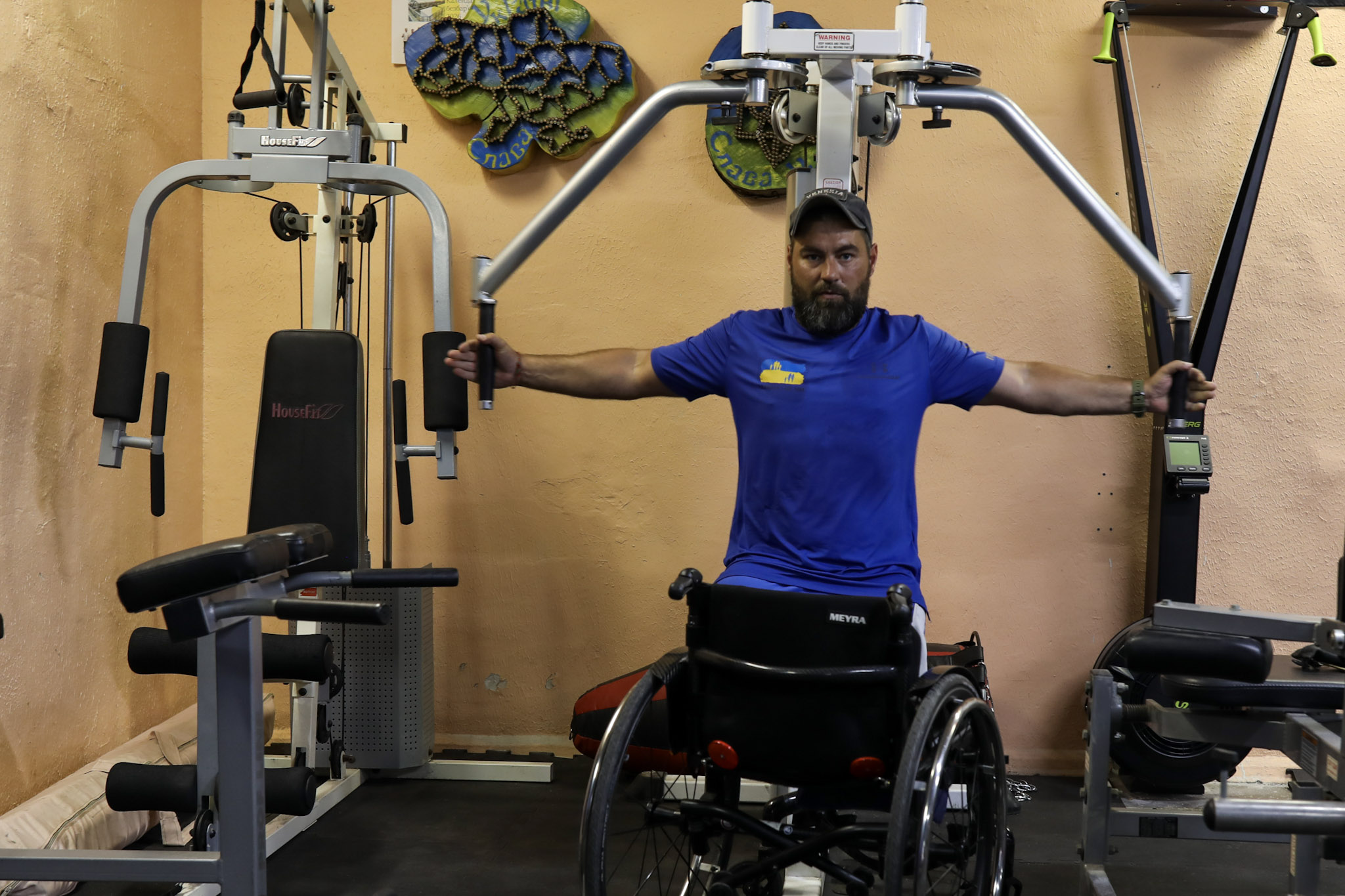
In the middle of the lot stands the core of the future complex—several containers joined together and converted into bedrooms. In between them is a spacious living room with particleboard flooring, which opens onto a small kitchen and a makeshift gym, where bicycles and exercise machines are scattered among tables, folding chairs, and items that look as if they were brought in at the last minute.
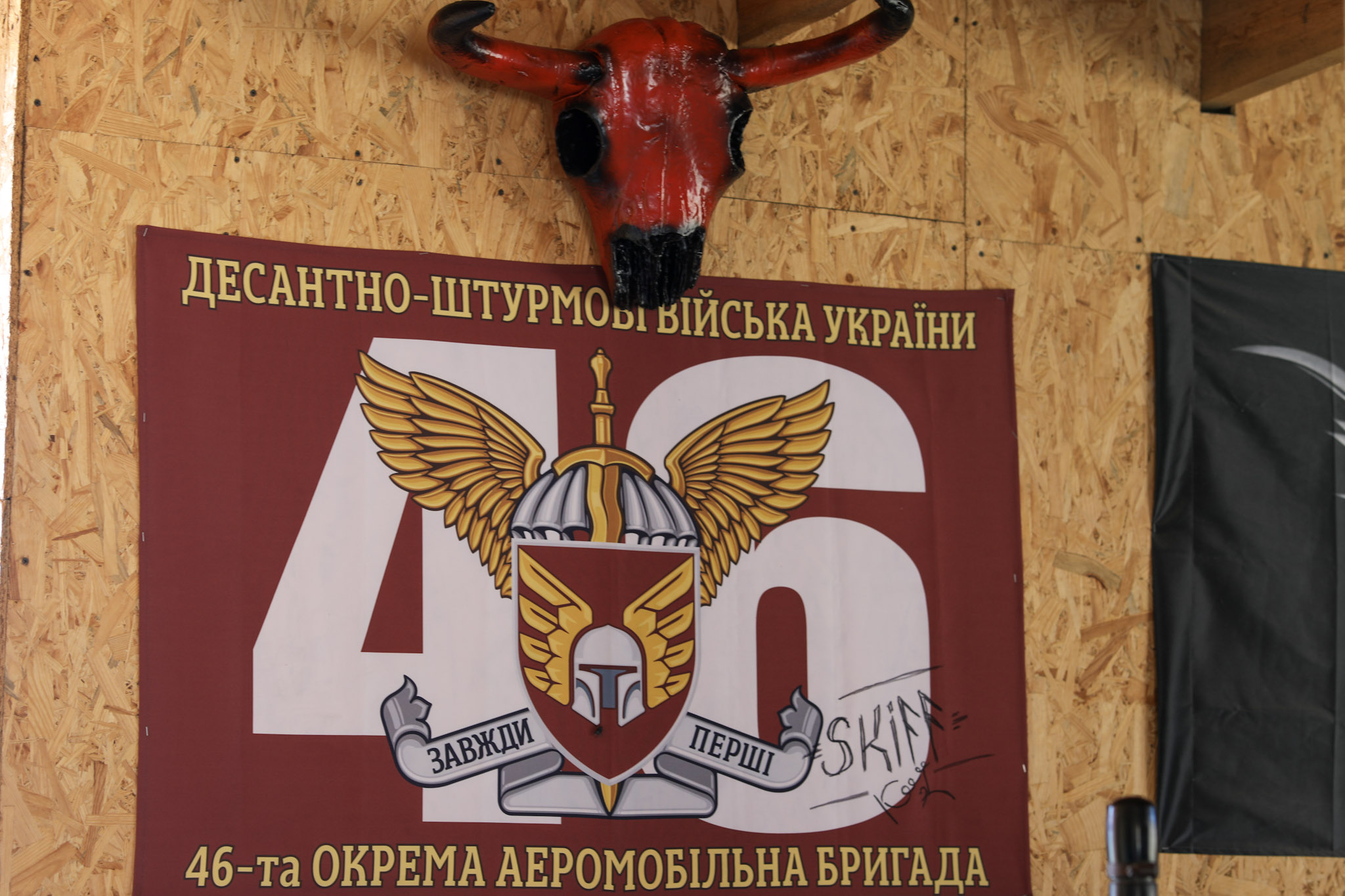
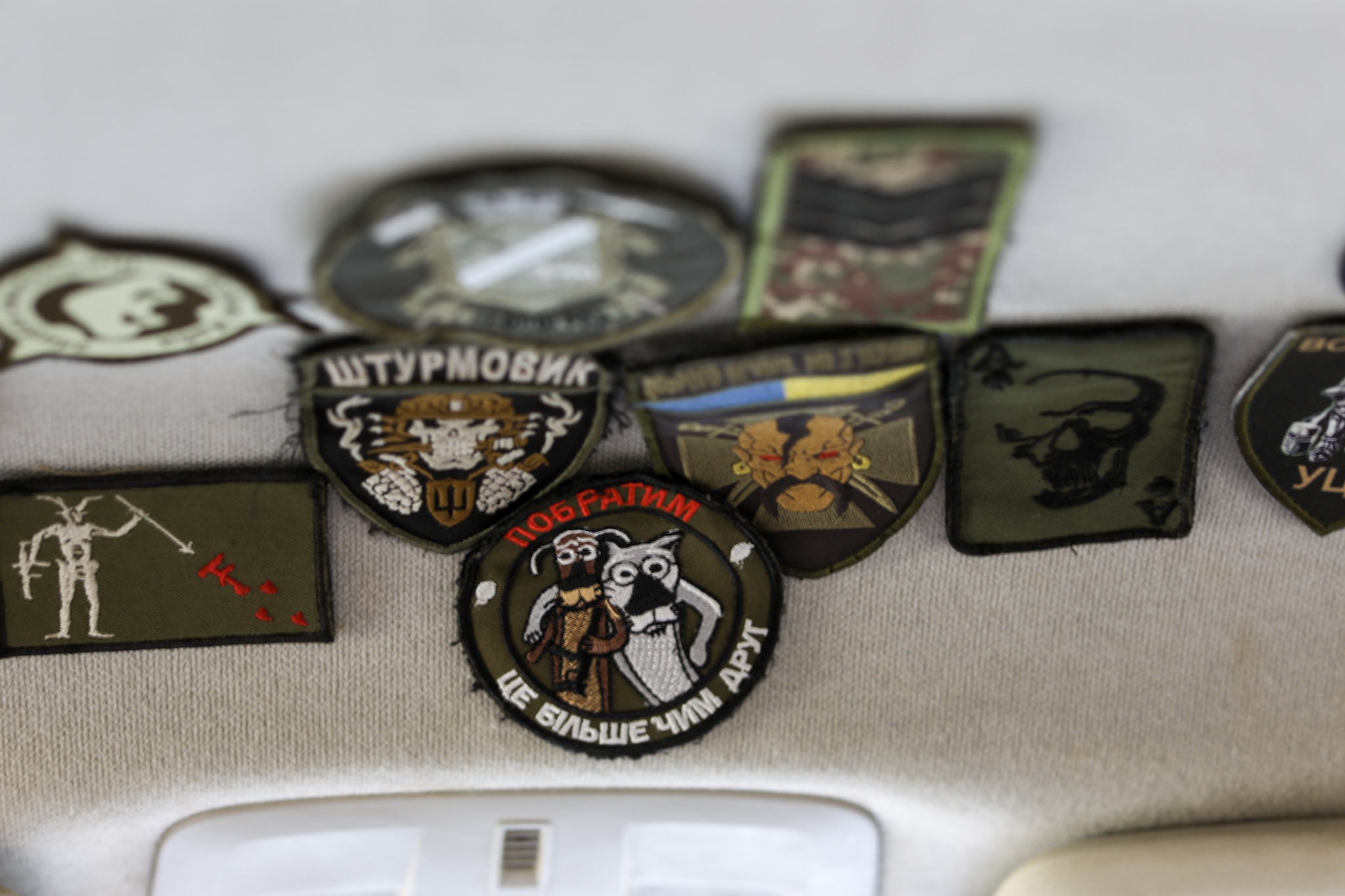
The walls, made of wooden planks—which reveal the still-temporary nature of the place—are decorated with Ukrainian flags and the emblems of various brigades: beneath the black horns of a bull’s head painted red, the number 46 and the motto “Always First”; next to it, a wolf’s head framed by a trident and a Ukrainian flag covered in signatures.
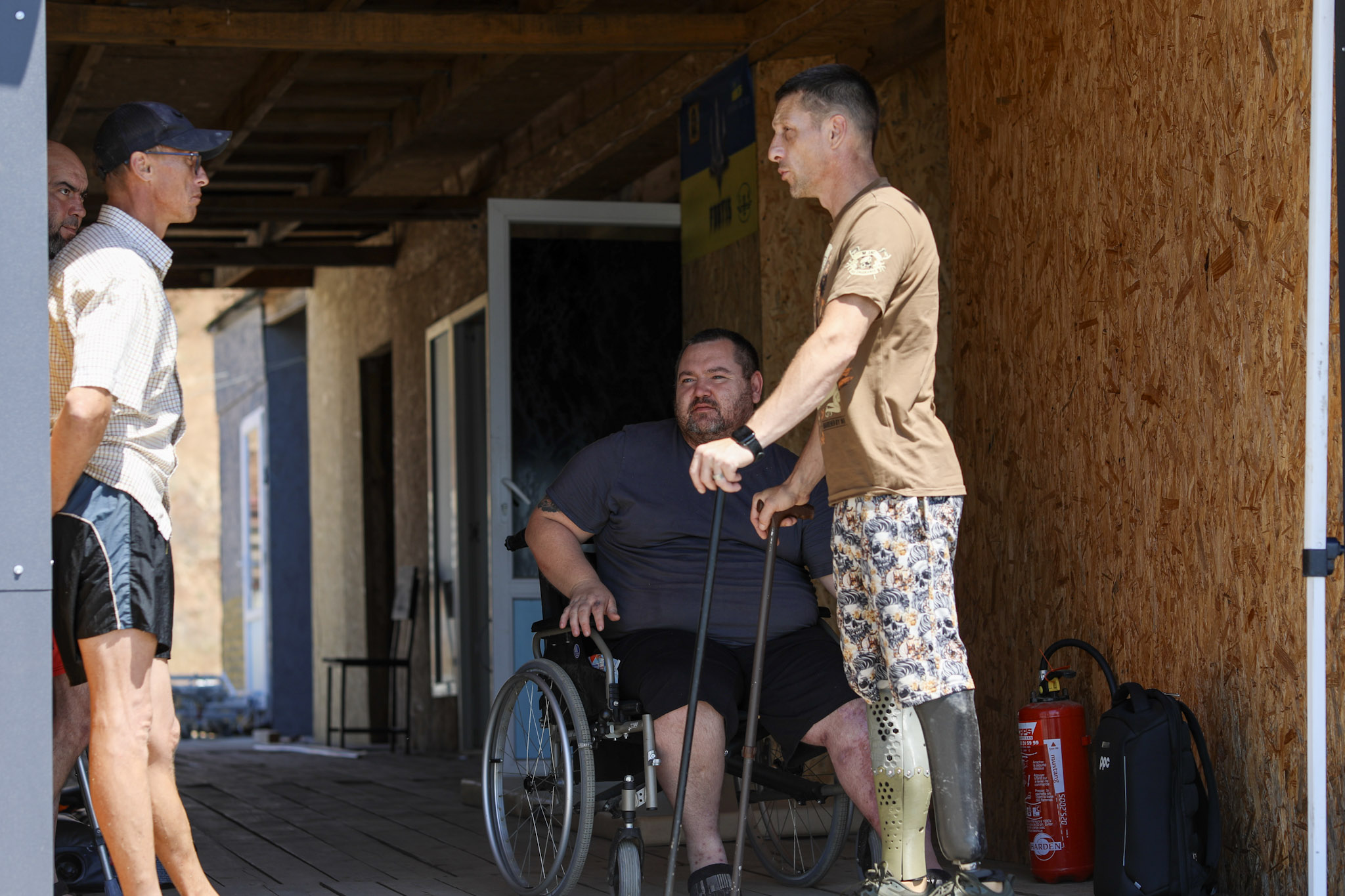
At the entrance to the complex, a white dog with orange spots on its belly is sleeping lazily and doesn’t even lift its head as a man of about 45—athletic in build but leaning on crutches—walks past him, talking loudly on the phone:
— Roman, look, we’re buying all this equipment for the Ukrainian Maritime Events Federation, and I’m Denis the Jew, captain of the Odessa unit. Our team consists exclusively of boys who have suffered serious injuries, but we row so well that we’re already Ukrainian champions and European champions— all while wearing your gear. We’d like you to give us a wholesale price, at least this once, because this is already the third time we’ve bought equipment from you.
— It’s for the civic organization “We Are Ukraine,” right?
— Yes. And second, I’d like you to understand what an honour it would be for Under Armour to become our sponsor. If I start explaining who I am, you’ll say, “Yes, I’ve seen you.” “I know who you are!”
— Most likely, yes.
— We find it very comfortable to row in your gear, and your products are of very high quality.
— Would you like us to provide these products as a sponsorship, or would you like to purchase them?
— Actually, we want you to become our sponsors—not just for clothing. We are the most famous in Ukraine. There’s no one stronger than us. In a single boat, when we row, we have seven veterans who are missing a total of nine limbs. And we take gold, wearing Under Armour. Get it? We’re actually promoting you!
— Yes. I’ll pass all of this on to management and then get back to you with an answer. Until then, I’m waiting for your sizes.
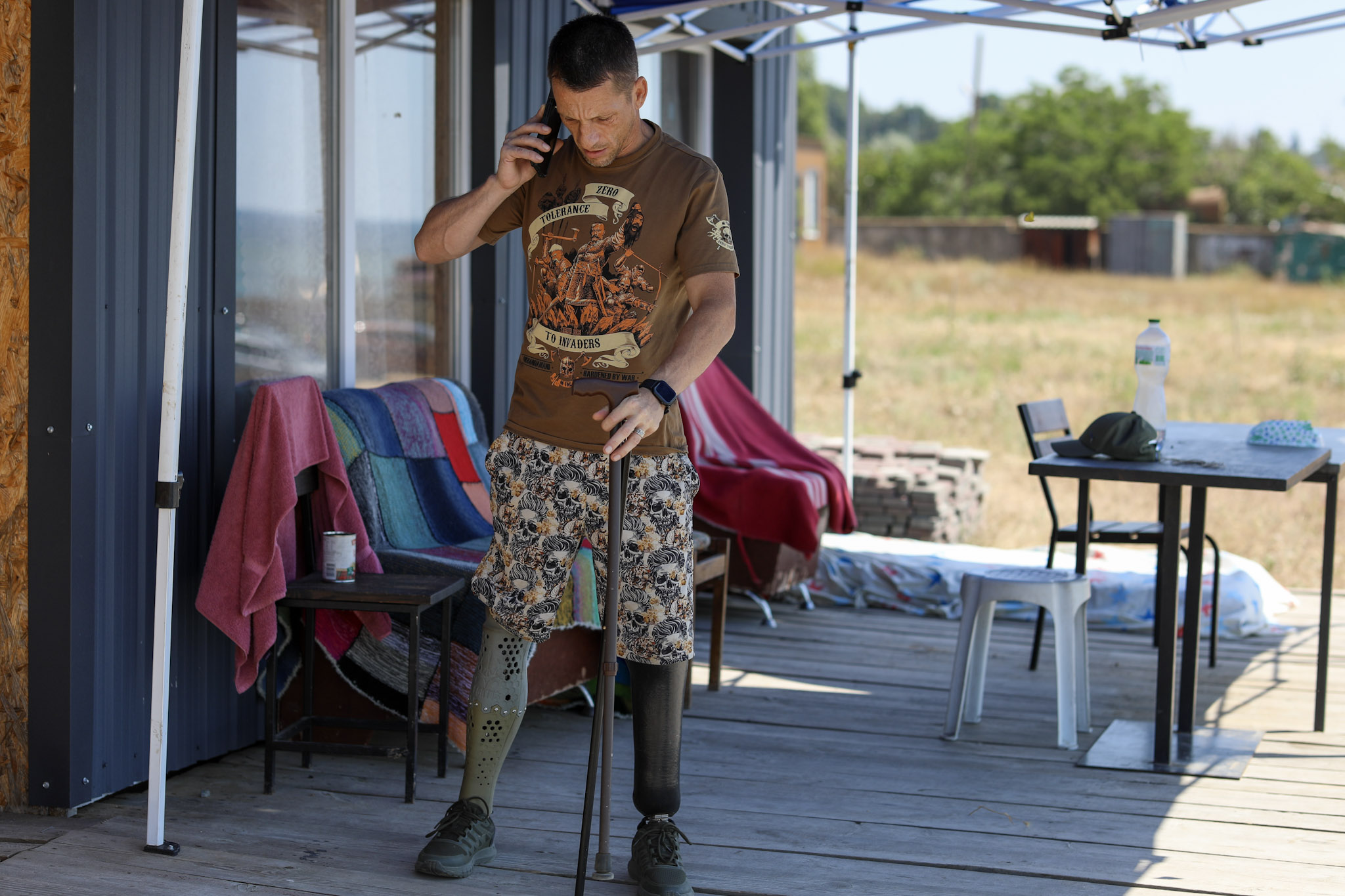
The man ends the call with a smile. His name is Denis Chernenko, but in Odessa he is known as Denis Evrei, which means “the Jew.” The nickname originated on the front lines, from a barracks joke. After a gruelling practice, the teammates were lounging around, and Denis—whose sharp wit often lightens the mood when things get boring—asked a boy with dark skin if he happened to be a “Gypsy.” Not to be outdone, the boy retorted, “Jew.” Based on which criterion, Denis doesn’t know. But in war, a nickname is easier to remember than a name, he explains.
He puts his phone in his pocket and greets a few of the men gathered in the living room. One of them, Sergei, whose face is swollen and cut, has been at the centre for a day. He was recently discharged from the hospital; he’s still taking medication and looks around anxiously. He isn’t quite sure where he’s ended up or what he’s going to do with his life. Denis shakes his hand firmly, looks him over for a moment, and tells him that he needs to see a doctor, that he’ll help him with whatever he needs, and that he can stay at the centre until he recovers.
Artiom, another veteran, watches the scene from a wheelchair. His feet are swollen like watermelons and covered with scabs. However, Denis says that Artiom finds something to do every day: he paints a section of the wall, fixes something, or moves something around.
Gherman, a gaunt man with glasses perched on his nose, had come from Kharkiv with his dog nearly two months ago. He was scared and exhausted. “Now, he walks around downtown smiling, does live streams on TikTok, and wakes up to watch the sunrises over the sea, which are incredible,” Denis recounts.
The centre on the Black Sea coast is not officially open. And yet, the veterans have already started to show up. Police officers, soldiers, former comrades, or doctors call Denis when they have someone who can’t manage on their own and ask if they can send that person here. Others find out about the centre on their own and write to it directly. “There’s no need for a psychologist. We look out at the sea, and it helps us,” Denis argues.
The place grows along with the people who come here. The veterans build sheds and porches, do repairs, paint, and mow the lawn. But they’re not alone, Denis explains. On the weekend, civilian builders also come by; instead of spending their two days off at home, they volunteer at the centre.
“It shouldn’t be built solely by veterans,” Denis believes. “What’s important is that it be led by a veteran’s heart. No one understands us the way we understand each other. Sometimes, not even those closest to you can.”
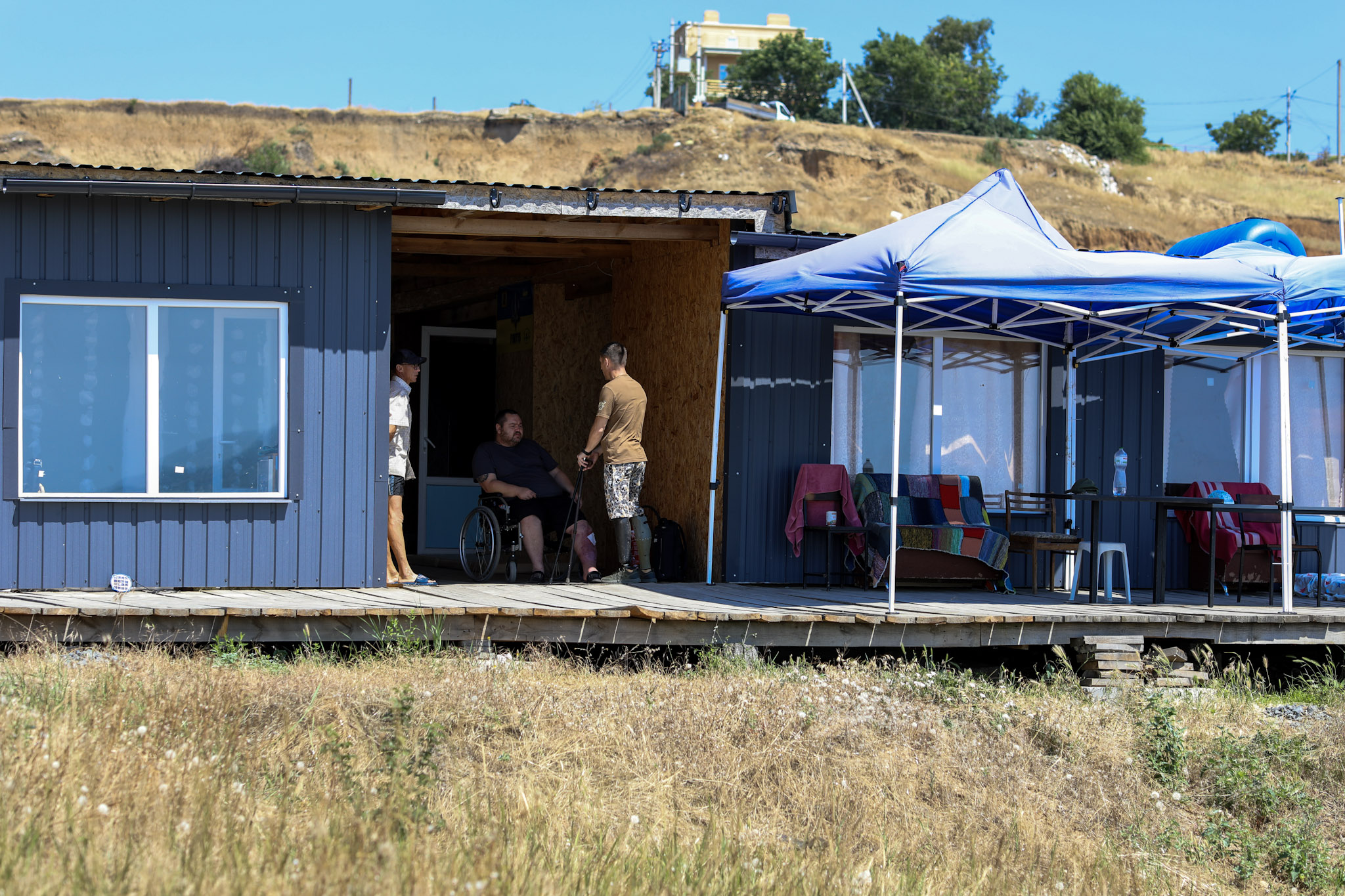
In his mind, the centre is as good as finished. He envisions it as a large, modern, and bustling place: with cottages where veterans can stay with their families, rehabilitation and fitness centres, training sessions at sea, terraces and barbecue areas, music, a bar, and a business hub run by veterans themselves.
“Anyone who just wants to stay for a few days and breathe in the sea air is welcome to come and do just that. Anyone who wants to go in for sports, they should find sports here. Anyone trying to build a business should get help to get it off the ground,” Denis says. According to his plans, the centre would eventually be able to accommodate up to 240 people.
But above all, Denis wants a place where people returning from war won’t be left alone. A place where none of them would ever feel forgotten or abandoned again, but rather surrounded, first and foremost, by friendship and love. „This is the purpose of my entire life. The project of my life. “Because, you know, no one understands us the way we understand each other,” he repeated with a sigh.
Denis the Jew’s “life project” currently rests on a legally precarious foundation. In that area along the Black Sea coast, known for its beaches and new residential and recreational complexes, the veterans have documents and an official address only for a tiny structure—measuring 1 by 1.5 meters. The rest of the complex is located on a piece of land that Denis calls “no man’s land” and which he is trying to acquire legally.
“They even brought the police here. They believed that whoever was stronger would take possession of the land. But when they realized that we were fighting for it, they stopped. To get us out of here, they’ll have to kill us. I’m not kidding. In Ukraine, the laws don’t always work, and you have to find all kinds of loopholes. We have an address for this building; we’ll make our way there, and from there, we’ll continue our fight. If you take care of a piece of land that doesn’t belong to anyone and can prove it, there is a way to acquire it. “That’s the path we’re taking, too,” Denis explains his strategy, sitting on the terrace and gazing at the sea and the horizon that seems to merge with it.
On the terrace, for a few moments, everything seems to be in its right place. The sun shatters its light into thousands of shards on the mirror-like surface of the water; from the beach comes the clamour of children riding inflatable unicorns; Sergei and Artiom are nailing a curtain in place as a door to one of the shipping containers; and Denis gazes serenely toward the milky horizon.
Suddenly, a shrill buzzing sound, like that of a swarm of angry wasps, rang out above their heads. For a second, no one moves. Denis’s sharp voice snaps them out of their livid stupor:
— Drone! Hide!
***
The drone drops a gas grenade into a shelter in a field in the Zaporizhzhia region. The eyes of the five soldiers inside begin to water; their coughing almost makes them cough up their lungs, and the air struggles to find its way into their chests. It’s been a day since they took up their position, with the mission to hold their ground and not give it up.
They wouldn’t leave the shelter as long as they knew Russian drones were swarming overhead, but their bodies act before their minds do—they’d rather risk death outside than suffocate inside.
The five of them rush into the narrow ditch in front of the shelter when another drone drops an explosive payload among them. For a few seconds, New York is nothing, but an explosion, smoke, and dirt thrown into the air.
In this context, New York is not the American city with skyscrapers. It is a hole dug in a field, about four hundred meters from the Russian positions, with walls and a floor supported by damp crossbeams and a tattered curtain hanging at the entrance. There aren’t any trees or bushes around. Just the field, torn up by artillery shells, and a single narrow path connecting New York to the neighbouring position, called Rome.
Denis can’t hear or see anything. He doesn’t even know where he is or if he’s alive anymore. He can only hear his own cough, which tears at his throat.
When the smoke had cleared a little, he tried to look for his comrades. He tries to crawl, but he sees his right leg. The shin, twisted in the wrong direction, with the boot still attached to his leg, is held to the rest of her body by nothing more than a strip of skin.
Everything happens so quickly that the pain is slow to set in. He hears the buzzing above him again and instinctively rolls around the corner of the shelter before the drone drops another load.
Explosions, screams, chaos, blood, groans.
In the midst of this madness, Denis reaches for the tourniquets. He applies one. The blood keeps flowing. He tightens the second one, higher up. Then he takes the spare barrel of a machine gun and ties his mangled leg to it, as if it were a splint.
He calls out to Pasha, one of his comrades. Nothing.
He tries to get up, but his body pulls him back down. The explosion also tore off his left foot.
He calls out to Pasha one more time.
After a while, a moan breaks through the curtain of smoke. Denis breathes out deeply. That means he’s alive.
Beside him, Donbas and Alabai, two other comrades, lie motionless, and the buzzing…
***
The buzzing sound slowly fades away over the sea.
Denis looks down at his prosthetic limb and exhales quietly. “[The drone] is a recon one,” he notes. “We got away.”
In front of him, the children continue to play on the inflatable unicorns, and the sun continues to cast its light over the water.
When the Russian invasion of Ukraine began four and a half years ago, Denis didn’t hesitate for a moment in his desire to enlist. On the contrary. He went to the military recruitment office and introduced himself: Denis Chernenko, he wants to fight.
“I was a romantic. And I’ve always had a soft spot for people in uniform. They seem to me to be the strongest and most invincible.”
They listened to him and sent him home. He had not served in the military and had no military training. They’ll call him when the time comes, they told him back then.
The answer left him almost speechless. Denis was in excellent physical shape; he had been boxing for years, had been a champion in Odessa, and subjected his body to workouts that would have been impossible for others: hours of running in the scorching heat, weight training, and boxing until he was completely exhausted. He couldn’t understand why an army at war didn’t need him.
He returned home, but he couldn’t settle in there anymore. From time to time, he would return to the military recruitment office and ask:
— What about me?
— We’ll let you know, the same voice replied.
He put up with it for nearly a year. Then he went straight to the National Guard gate. He told the boy who greeted him bluntly that he wouldn’t leave until he spoke with their boss.
They accepted him and began preparing him for several specializations. He underwent airborne training, followed by reconnaissance. Denis insists that they are two completely different things, each with its own tactics, reflexes, and way of surviving.
There he met some guys he still remembers with a smile. Once, one of them had just come out of a pond after a training session in which they had to wade through the water carrying all their equipment.
“To give you an idea,” Denis explains, “the equipment weighed about as much as you do.” If you weighed 70 kilograms, you were carrying around another 70 [kilograms] with you. If you fell on your back, that was it—you’d just stay there, flailing your arms and legs like a beetle lying on its back.
The boy had come out soaking wet. The others were waiting for him and asked him, laughing:
— So, how is it? Good?
— Yeah, it’s no big deal. It’s just my underwear that’s wet.”
Life felt different in the barracks. It was wartime, but there was still room for laughter, for silliness, for friendships that formed quickly, and for the feeling that nothing could touch them—that they were invincible—as long as they stayed united and looked out for one another.
After many months of training, in the fall of 2023, Denis arrived in the Zaporizhzhia region. At first, he was assigned missions that didn’t seem to put him in mortal danger every day. He drove the truck and was always on the road: he transported everything that needed to be moved from one location to another—supplies, equipment, the wounded, the dead—and took part in evacuations. All around them, shots were being fired, artillery shells were exploding, the wounded were moaning, and the dead lay silent, but the war itself had not yet reached him directly.
“And I really liked it. I was the one driving, and I love to drive. It wasn’t even that risky. I thought the whole war would be like that.”
When winter came, his unit no longer had enough soldiers to hold its positions. And at a time like that, no one asks you anymore if you want to, if you know how, if you were prepared for a certain mission, or if that’s your area of expertise. When there are no people left, all these differences become a luxury.
That’s how Denis ended up being assigned a task he had never done before. In fact, for the first time, he was to defend a position right on the front line, where Russian troops were stationed just a few hundred meters ahead.
The commander, he says, wanted at all costs to push the front line further forward on the map. Denis, Pasha, Alabai, Donbas, and one other soldier were supposed to move into a position called “New York,” hold their ground there, and defend it for four days. On the fifth day, others were to come and take their place.
Denis knew what New York was like—an open field, with nothing to hide him, drones constantly swarming overhead, and a tiny shelter, no bigger than a badger’s burrow. He also knew what their chances were of getting out of there unharmed.
“One in a million.”
But he did not question the order, even though he did not agree with being sent off as cannon fodder. They packed their belongings, and in the dead of night, the five soldiers slipped away toward New York.
***
Denis is sitting in the living room talking with the guys gathered around him. The phone rings again. He says he can get as many as a hundred calls a day and that he answers them all. He looks at the screen, and his face softens: it’s Vitalii Holodok, president of „We Are Ukraine,” an NGO co-founded by Denis, through which they established the “Consequences of War” Rehabilitation Centre. At the same time, Holodok is also the president of Odessa branch of the Ukrainian Maritime Events Federation.
— Vitalii, we’ve almost convinced the people in charge of the equipment. But we promised them we’d win the championship in Kiev, so we have no choice. We need to put in a good performance and make sure there are no surprises.
— We’re fielding a strong team. We’re going to give a good performance.
— We already have fuel.
— There is fuel. We have this.
— And I need the estimate for the 120,000 [hryvnias] in PDF format so I can send it to Kyiv. I’m about to start storming them.
Denis almost treats it like an accounting task—something that, in fact, takes up a good part of his new life: he brings people, money, and journeys together. In two weeks, along with the Odessa veterans’ team, they are set to participate in the Ukrainian Rowing Championship, which will also feature team competitions for war veterans from Odessa, Kyiv, and Dnipro. And they still need to come up with 120,000 hryvnias to cover the trip.
At one point, a car pulls up at the centre’s gate. They came for Artiom, the young man in a wheelchair whose legs were swollen and covered with scabs. He has to go back to Mykolaiv to finalize some paperwork. Nostalgia is already evident in his eyes, and, his voice choked with emotion, he squeezes Denis’s hand.
— I’ll be back. Thank you for everything.
— Yeah, sure, little bro. You’re one of us, Denis assures him.
While Artiom is helped into the car, Denis opens the door of his car: a tiny red Citroën with a personalized license plate reading “EVREI” and modified so he can drive using only his hands.
After losing both his legs, one of the things he couldn’t come to terms with was the thought that he would never be able to drive again. “I bought three cars in a year before I found this one,” Denis explains as he takes off his prosthetic and rests it on his arms.
For the Citroën, he bought a very simple control mechanism online: a lever mounted next to the steering wheel that controls both the accelerator and the brake. Denis pulls on it to speed up and pushes it to slow down. The pedals are still in place, so the car can also be driven in normal mode.
The phone rings again. Denis looks at the screen and smiles slyly. „Oh, we’re about to get some new funding. „Yes, hello! Look, let me tell you who I am—Denis the Jew. Have you heard of me? Do you know what we do? Write on the Internet – Denis the Jew.”
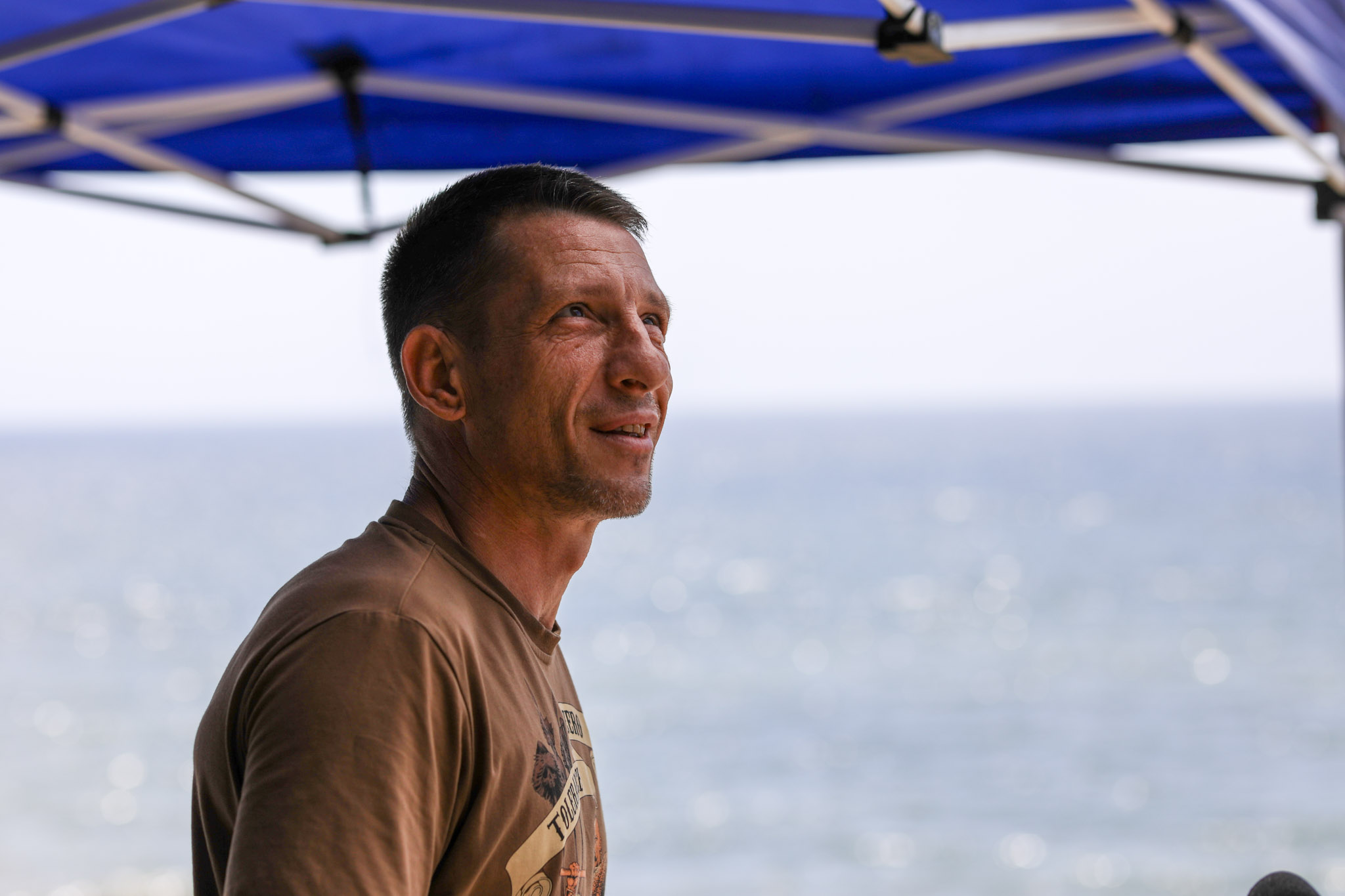
Then he takes off. He has to get to the gym.
He drives like a maniac. He loves speed and makes no secret of it. He says he’s even taken a course in defensive driving, and although the way he drives doesn’t always put passengers at ease, he boasts that in his entire life as a driver, he’s never hit another car. “Not a single scratch,” he emphasizes smugly.
The gym he goes to is located on the campus of the „I. Mechnikov National University of Odessa.” Sports had been a part of his life long before the war, and now he needs them perhaps more than ever. But there’s something else about this gym that makes him enjoy coming here just as much: almost everyone there is just like him.
When he sees Evhen Kaus, Denis’s face literally lights up. Jenia, as his colleagues call him, is a veteran and a certified rowing coach. He has blue eyes, a thick beard, and both legs amputated above the knee. Originally from Kherson, he now lives with his family in Odessa and is a member of the region’s adaptive rowing team.
“That’s my soul,” Denis seems to let slip. He doesn’t even have the patience to park properly anymore. He hurries his prosthetic legs toward the tree under which Jenia has taken shelter from the sun.
— Hey, bro! How’s it going?
— I’m looking forward to our practice.
They hug each other, pat each other on the back, and immediately start planning their evening workout. An “important person” is supposed to come with them on the boat, and everything has to go according to plan. If they manage to convince him that their team deserves support, maybe they’ll get at least some of what they need for the championship in Kyiv.
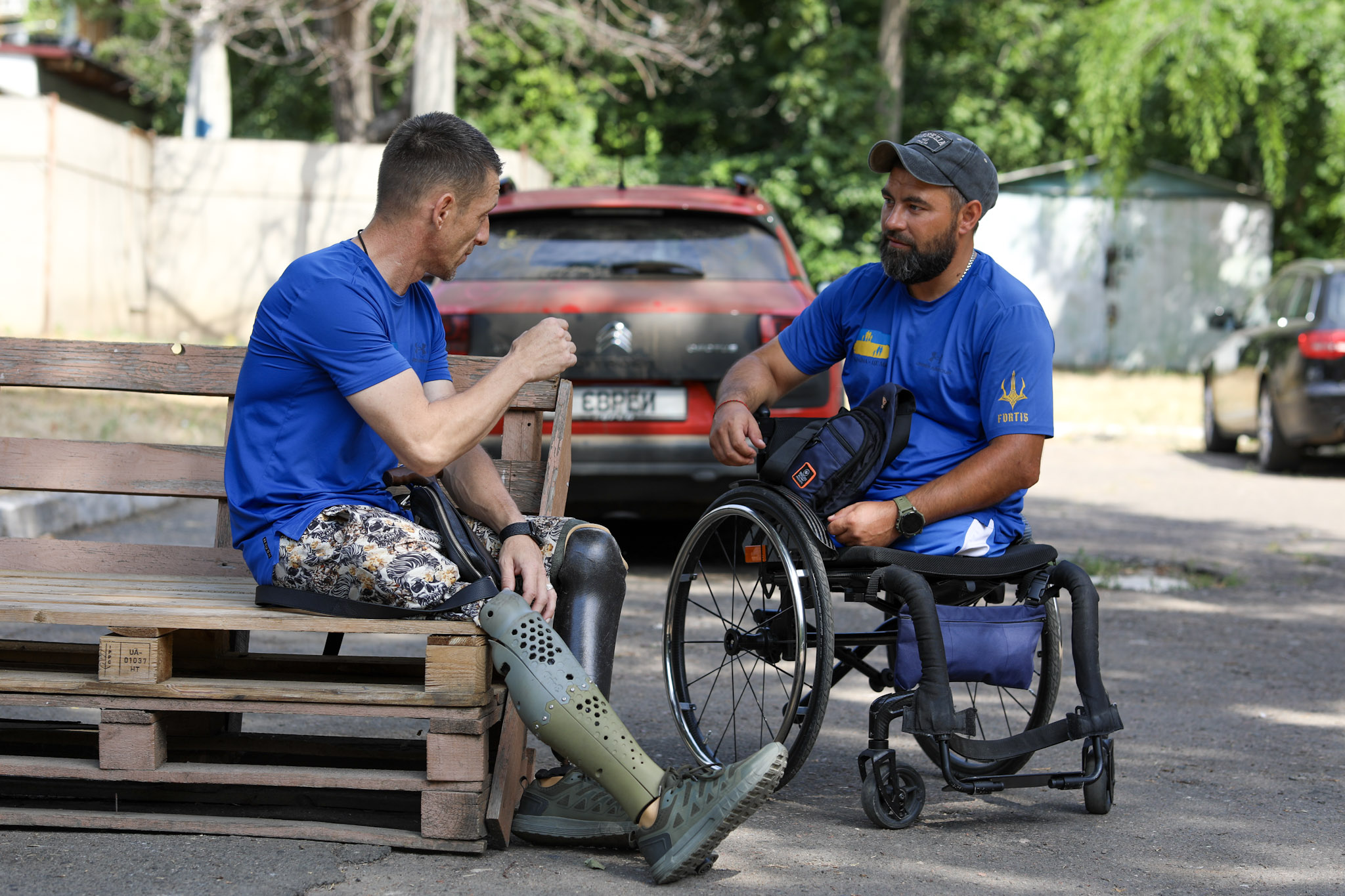
A young man with one hand missing appears in the doorway of the hall. Denis, in all seriousness, explains that he lost it after searching for honey in a beehive hidden inside a tree hollow.
For a moment, the story seems absurd enough to be true, and you even find yourself wondering just how foolish you’d have to be to stick your hand in a hive. Then Denis bursts into hysterical laughter. “I just love seeing the looks on your faces when you believe this story!”
The young man’s name is Vitalii, and he is one of the gym’s trainers. He works with both veterans and children with disabilities.
Standing next to him is Dima, a man who looks like a terrier ready to pounce on you. When he got out of prison, Denis was one of the people who helped him find his place among others. Ever since then, Dima has been one of his closest and most loyal friends.
“He’s helped me, and he’s always there for his people. I mean, for us. That’s why we appreciate him,” explains Dima. Without having heard him, Jenia says almost the same thing about Denis. Among themselves, however, their gratitude doesn’t stop them from joking around. The others tease him, saying that Dima didn’t even get a good look at the war, since he spent so much time “behind bars.”
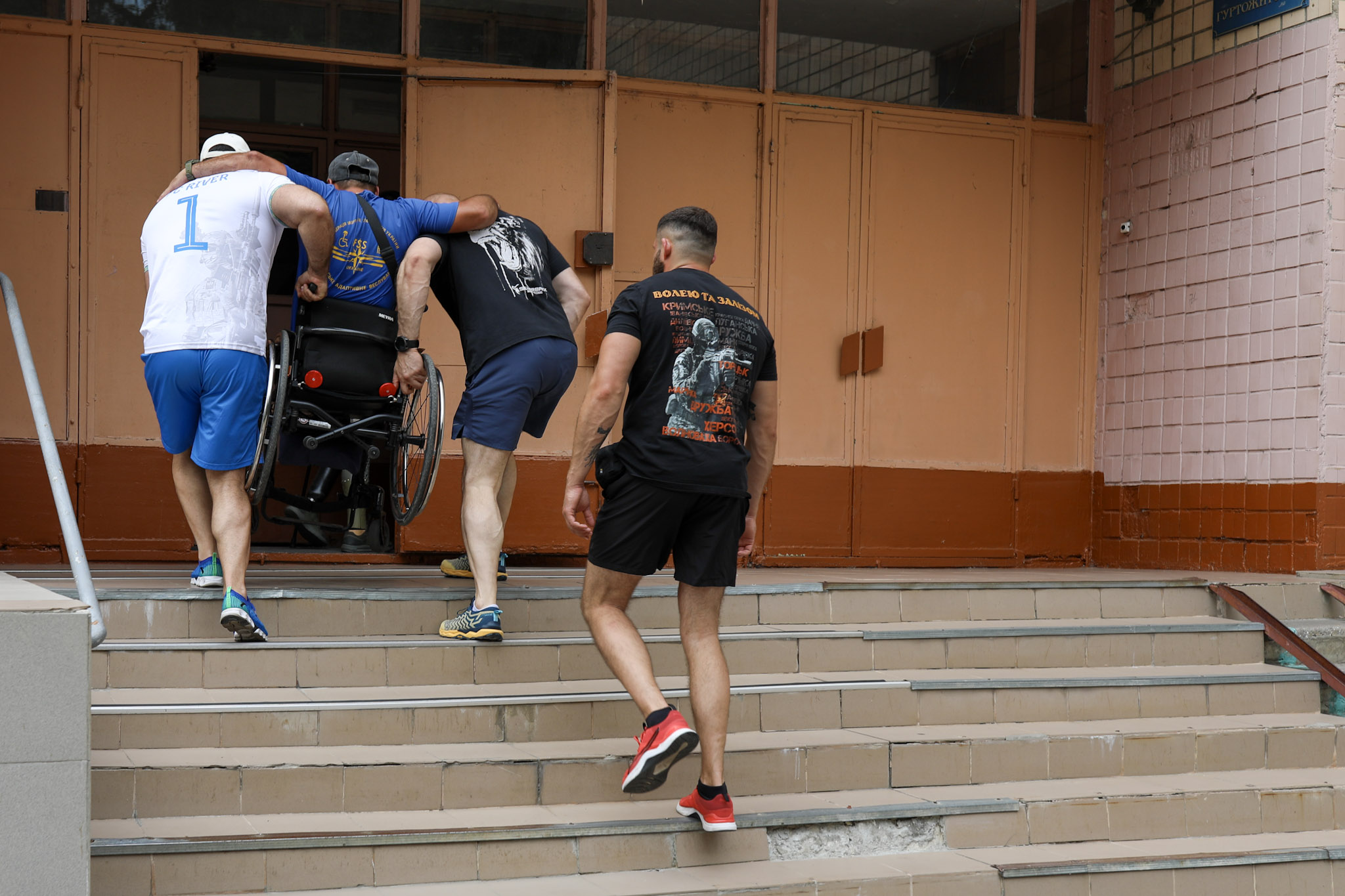
Dima laughs and doesn’t seem to mind. When it’s time to take Jenia inside, he grabs him under the arms and carries him up the stairs. With no legs, Jenia’s body hangs in his arms like a mannequin from the market.
There is no access ramp. They are just two metal bars lying across the steep steps—a makeshift arrangement that Denis calls a humiliation. But they have no choice. They’re going to meet with some Americans, and maybe they’ll manage to convince them to donate money so they can build a real one.
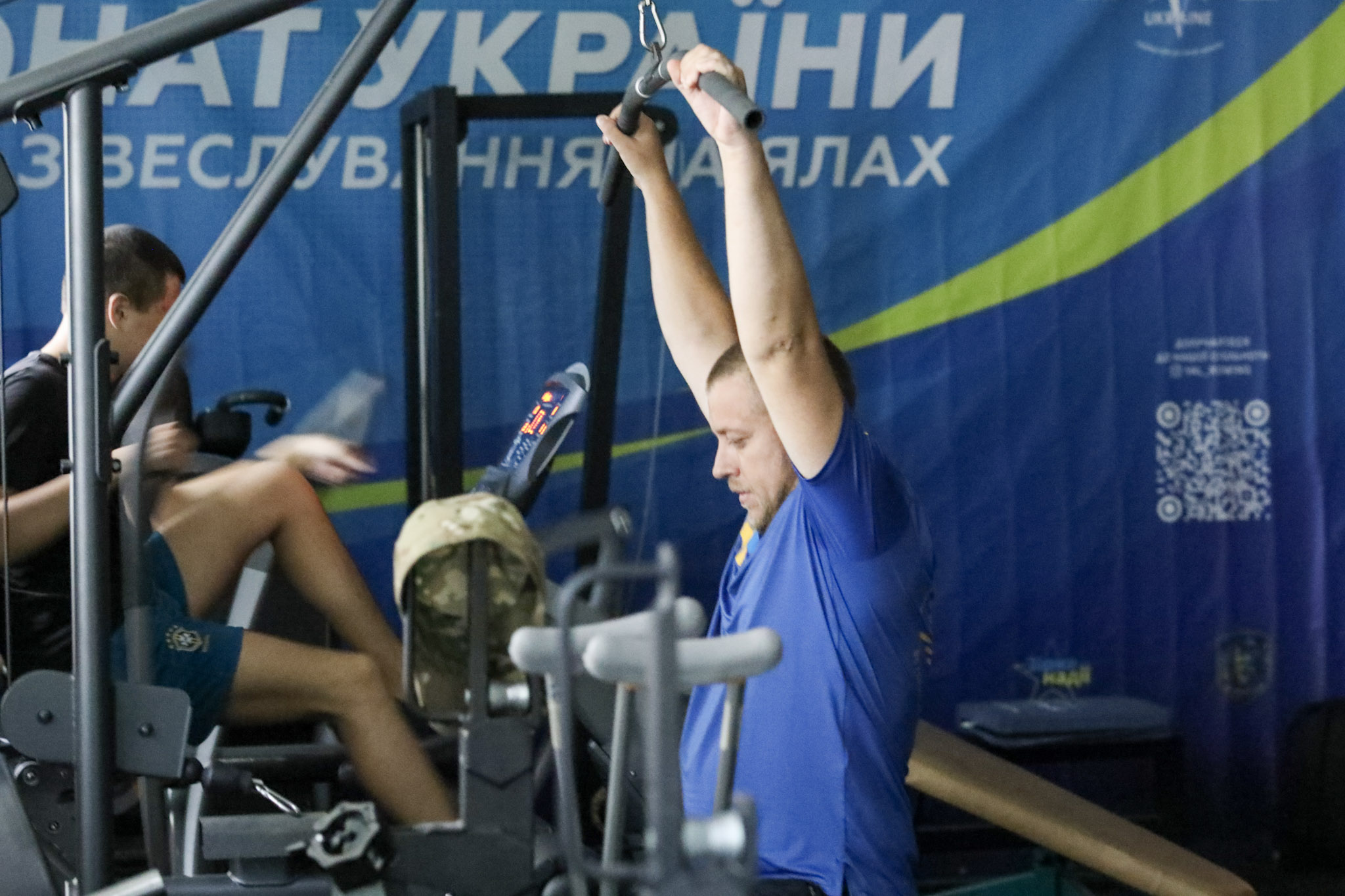
The fairly small gym is packed with exercise machines and people. Young boys and men in the prime of life. Each of them lost something in the war: an arm, a leg, both legs, and sometimes both arms. A veteran on crutches greets people with almost no words, sits down next to a machine, and starts lifting weights. Dima moves among them and gives them instructions.
The place serves as both a training hall and a small museum showcasing the things the people here managed to create after returning from the war. In addition to flags, military insignia, and the FORTIS logo—the name of the international project that brings together some of their sports rehabilitation activities and participation in international competitions—the walls are lined with photos from the competitions they’ve participated in, certificates, trophies, and dozens of medals.
Denis feels right at home. He stops near a blonde with the body of a goddess. “Oh, Olechka, what a beautiful comrade I have!” he exclaims, and quickly adds, “She’s Vitalii [Holodok]’s wife.”
Olga is used to Denis’s compliments. She’s been working at the gym for a few years and has remembered him ever since she first saw him walk through the door: on crutches, with his prosthesis freshly fitted.
“He didn’t complain or whine, as so many do,” she recounts. “He tossed his prosthetic aside and started lifting weights.” He also remembers that he donated money so that the gym could buy certain pieces of equipment.
Jenia, who no longer has legs, Olga explains, needs a device that supports his body much like a corset, so that he can strengthen his back and arm muscles. Another veteran needs another source of support. Some people can work only with their arms, while others can work only with their legs. Everybody requires a different solution.
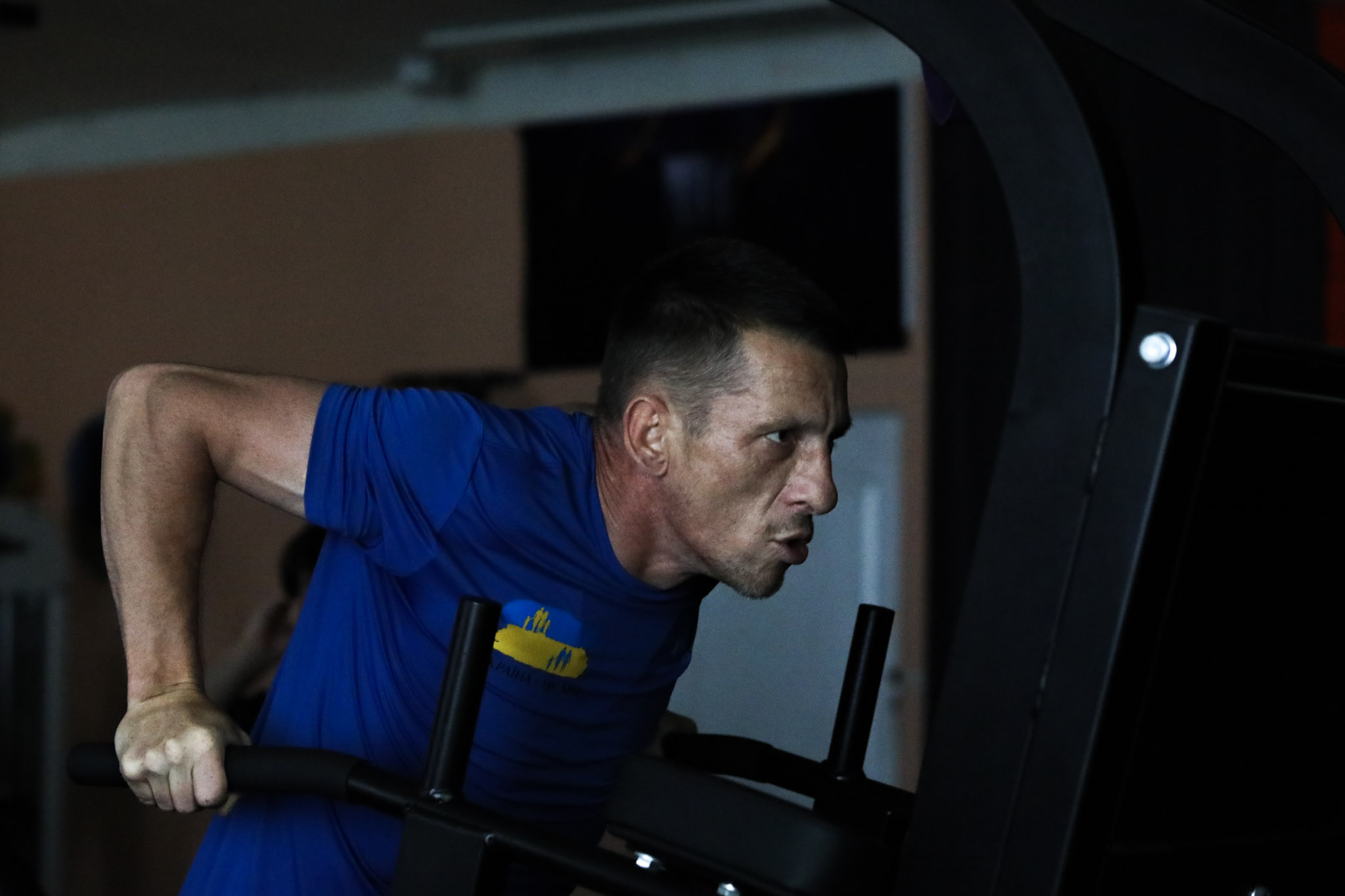
Denis grabs the pull-up bar and pulls himself up almost like an Olympic gymnast. Then he changes the device and continues. Toward the end of the reps, he grits his teeth.
He’s gasping for air.
He quickly wipes his face and heads toward the adjoining room, an annex where the administration and accounting departments are located. The Americans have arrived. They greet each other, shake hands, and exchange a few words. Shortly afterward, the guests ask to take a group photo.
“No,” Denis replies firmly. “In the end.”
He says he hates it when everyone wants to take pictures with the veterans. They need funds for gym maintenance, the ramp, equipment, and competitions, but people want photos. “Do they want pictures? Let them help first, and then we’ll take pictures.”
He tells the guests about the association, the tournaments they participate in, the veterans who train at the gym, and everything else they still need to buy. Denis speaks with the same vehemence with which, an hour earlier, he had been trying to convince someone else on the phone to provide them with sports equipment.
At one point, one of the boys turns to Jenia, the veteran whose legs were amputated above the knee. “Come on, get up and let that lady have a seat,” he urges him, nodding toward one of the women standing there.
Everyone bursts out laughing.
Jenia laughs the hardest.
The conversation with the American guests didn’t seem to please Denis. The meeting ends without any concrete promises, and that makes him grit his teeth.
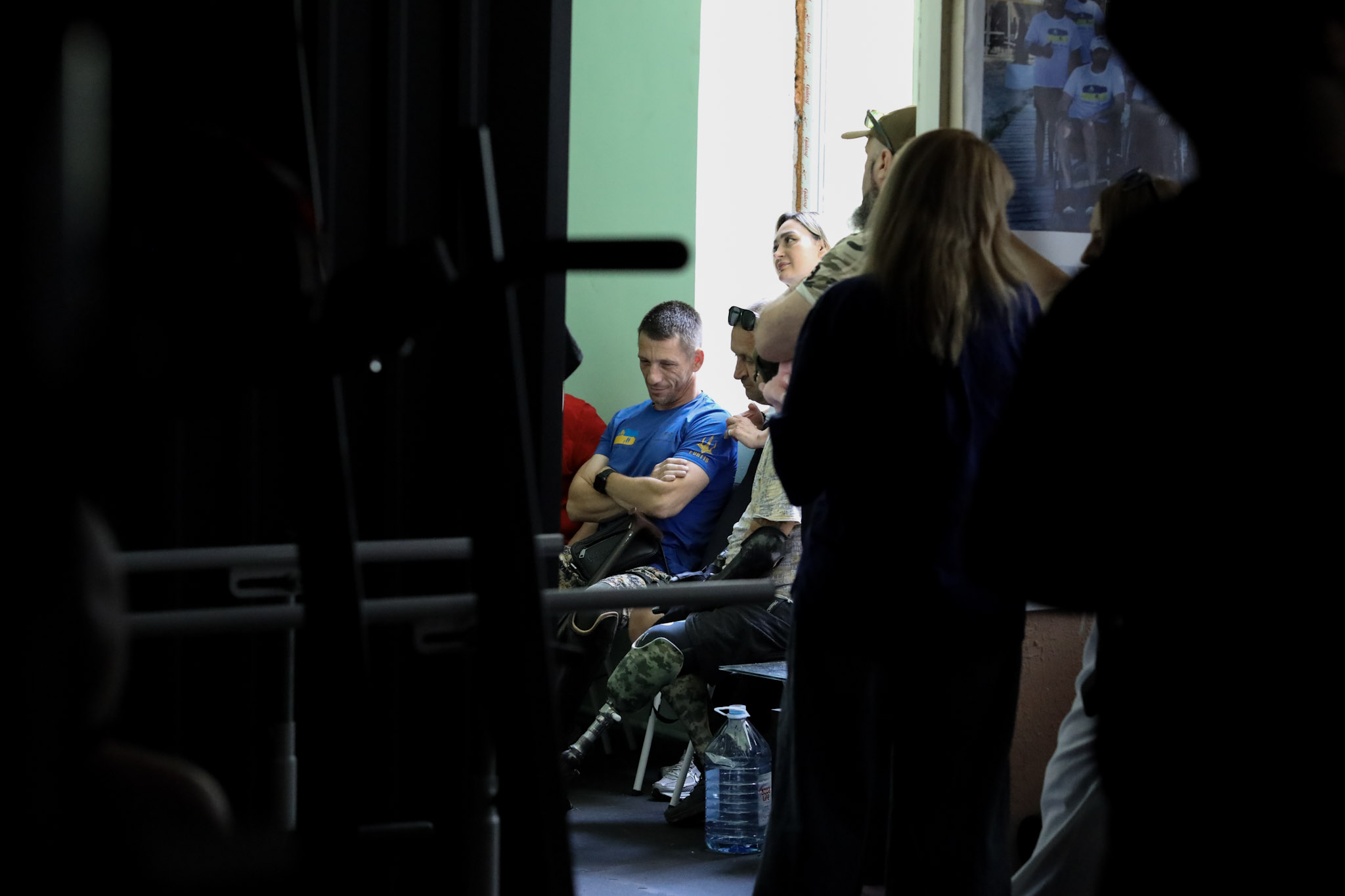
After they leave, practice seems to take a break. A flood of veterans pours out of the building and gathers in the shade of a tree in front of the hall. Some sit on a makeshift bench made of pallets, while others remain in their wheelchairs or stand.
Denis is, inevitably, the centre around which everything revolves. He talks to one person, calls out to another, answers the phone, cracks a joke, gives a directive, asks about the equipment, and then effortlessly returns to the conversation he started a few minutes earlier.
After several minutes of loud laughter, calculations, and heated discussions, they shake hands and agree to meet again at 4:00 p.m. by the sea, where the team trains on the boat both for competitions and as part of their recovery process.
In 2024, in their first appearance at a rowing championship held in Greece, the veterans from Odessa won the silver medal. Denis recalls how, before the race, the other competitors were filming them as they took off their prosthetics, seemingly unable to believe that they were about to compete in the same category as athletes without disabilities.
At first, they were watched with pity rather than as adversaries, Denis now realizes. A year later, the team returned to the competition in Greece and won all the races and the gold medal. They had pulled so far ahead of the team they’d lost to a year earlier that “we could have stopped to go fishing and wait for them,” he recounts with a laugh.
***
He gets into the Citroën. Before closing the car door, he takes off his prosthetic limb and places it where it belongs—on his arms. Before his boat training session at sea, he wants to stop by his house to change and freshen up a bit.
He hasn’t even had a chance to start the car when the phone rings. This time, on the other end of the line is someone who might be able to give them paint for the centre. Denis begins to negotiate. He isn’t asking for a few litters. They have entire walls to paint, bedrooms to finish, and very little money. He pushes the conversation forward, haggles relentlessly, explains who they are, what they’re building, and for whom they’re building it—and inevitably arrives at the argument he pulls out of his sleeve every time he senses that his conversation partner isn’t yet fully convinced.
“Have you heard of Denis the Jew? No? Look me up online. Now the Polish have made a movie about me. In just one day, it garnered two hundred thousand views. It’ll make it to Cannes, too.”
When the call ends, the centre has a few dozen litters of extra paint on hand.
He laughs with satisfaction. He has learned to turn his fame into a tool, and he doesn’t hesitate to use it. He says that ever since the veterans began to come together and take action, things they would previously have considered impossible have become negotiable: a door opens, a civil servant responds, an institution listens.
He talks about lawsuits, about stepping in on cases where veterans felt someone had been wronged, and about a conflict with representatives of the Territorial Recruitment Centre—an institution known by the acronym TRC—which has been the subject of several scandals due to the way it has handled the mobilization process.
“I simply got a veteran out of court—they wanted to send him back to the front,” he says, with the confidence of a man who has learned that, when it comes to the system, sometimes it’s not enough to be right: it also matters who speaks up for you and how much clout that person has.
But this power, Denis insists, is not his alone. “That’s what an organization is all about. When you’re alone, you’re just one person. When we’re together and everything is for real, that’s when you have power.”
He pulls away.
The Citroën speeds through the streets of Odessa with the same urgency with which Denis lives nearly every hour of his life. Nothing has changed: he drives like a maniac, his phone is right by his side, and “We Never Return” is blaring from the speakers again. The heavy violin blends with the electronic beat, and Denis begins to hum the melody that “gives me an adrenaline rush and brings me back to the front lines.”
For a few moments, his two lives seem to run parallel through the same car: the one he lives now, in which he chases after paint, money, boats, equipment, and competitions, and the other, which he can’t leave behind anywhere. “How could I ever forget the war? My legs will always remind me that I was there. Even without looking at them, the war is in them.”
He swallows hard, and his voice breaks into a sigh, a slight tremor that, for a few moments, he can no longer mask with jokes, music, or speed.
Before he was injured, Denis had returned home for a two-week vacation. He had been boxing for 11 years and was still training even then. He remembers his last boxing session: at 11:00 a.m. he was still at practice, and at 3:00 p.m. he was supposed to take the minibus to Zaporizhzhia.
As he was leaving practice, an absurd thought crossed his mind: if the war were to take something from him, which would he rather lose—a hand or a leg? He looked at his arms— strong, sculpted by years of boxing. Then at his legs, which were slimmer. And he thought that, if he had to choose, he’d rather lose a leg. In about two months, the war would make his choice.
Before all of this, Denis says he used to be a different person. More confident, perhaps a little more cheeky, always ready to prove something. Boxing had made him believe he could defend himself against almost anything. He says he could knock a man down with a single blow, and that this certainty gave him a sense of confidence that he now views from a distance. And that still hurts him. He doesn’t box anymore, and he knows that without his legs, he can’t return to the ring the way he used to.
“I’m much more modest now,” Denis says.
But the paradox of his life begins right here: now that he has less of the body, he once relied on, he manages to do things he never would have imagined before. He says that he was selfish before the war. “Extremely selfish,” he emphasizes. Now, when it comes to his boys, he seems capable of achieving just about anything. “For myself, I wouldn’t have been able to come up with millions, buy cars, or build things with almost no money. But for the boys, I can.”
***
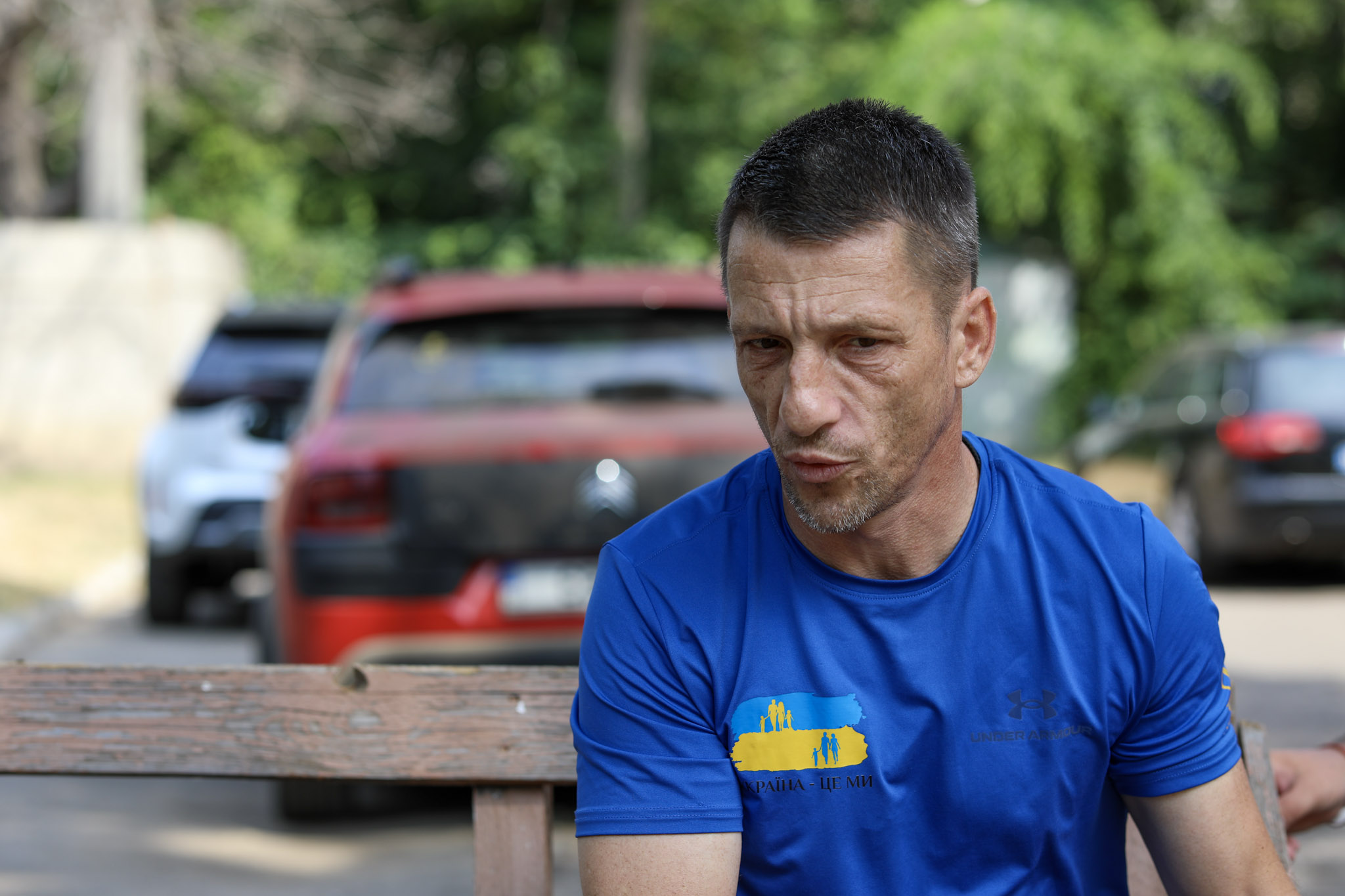
Denis never lacked energy or initiative in his previous life either. He had grown up in a family of four children, without a father, where poverty was not an abstract concept but a daily reality. For years, he had felt it as humiliation.
After graduating with a degree in maritime studies, he set sail and spent several years at sea. At first, he enjoyed it. It was the world he had always wanted—with ports, long roads, and money. But at some point, he began to notice that his son was growing up while he was always out at sea. He would leave for months at a time, and by the time he returned, the child was already a little different.
He gave up the sea.
On land, however, Denis wasn’t the type to just sit around doing nothing. “I used to smuggle goods with the Moldovans,” he laughs smugly as he weaves his way through the cars. “I used to bring good, juicy fruit from Palanca and sell it at the market in Odessa.” He recalls with an almost adolescent delight how they managed to smuggle the goods right under the customs officers’ noses without them suspecting a thing.
Then other business opportunities came along. He was making enough money to support his family and, more importantly to him, to give him the feeling that things were starting to take off. Just before the war, “I could walk into any restaurant and order the most expensive dish.” The poverty that had dogged him for so many years no longer dictated his life.
And he had plans. Many plans.
He wanted to see the world.
He wanted to raise his son.
He wanted to get his house in order.
And he also wanted a vineyard— a beautiful vineyard that would grow around the house, just as he had imagined it for years.
Then came February 24, 2022. Next, the New York position on the Zaporizhzhia plains. Then came the months spent in the hospital and in recovery. And, at the end of them, two prosthetic limbs.
During the 11 days he lay there, broken, in the shelter—surrounded by the dead, the cold, thirst, and the wait for an evacuation that never came—Denis didn’t think only of his legs.
He also thought about the things he had left undone: the son he hadn’t had the chance to raise the way he wanted; the house; the vineyard he had never gotten around to planting. “As I lay there, disfigured, my greatest regret was that I hadn’t managed to do all those things. “I regretted that I had put them off for later.”
He says that was when he understood something that he now repeats almost as a rule. “Do you want something and know you have to do it? Do it! Just do it and be done with it! Do you want to travel? Go! I’m trying to travel as much as I can now.”
He’s speeding up.
The Citroën is driving through Odessa.
“We Never Return” continues to blare from the speakers.
***
He pulls up in front of an apartment building. A dog as big as a calf—which, for some inexplicable quirk of nature, looks exactly like Dima, the gym coach and Denis’s loyal friend—is coming toward him. Denis gives him a quick pat and goes inside.
There is a wheelchair in the middle of the bedroom. He lets himself sink into it, and for the first time since morning, it seems as though he is truly stepping back from the whirlwind of his life as a folk veteran.
He likes negotiating. He likes to push open doors, persuade people, and feel a problem that seemed hopeless begin to give way. He also likes the authority he has gained. But the body keeps a separate tally of all of this.
He takes out his prosthesis. It often causes itching around the stump, especially when it’s hot outside. The prosthesis weighs about seven kilograms, and the carbon and layers of material that cover his leg trap heat like a shell. When the weather changes, the situation gets even worse. He gets pain, sometimes so intense that he almost climbs the walls. That’s why he comes home around midday and takes off his prosthesis. He takes another cold shower, stays a little while, and then hits the road again. “I have to take them off, so I’ll still have some strength afterward.”
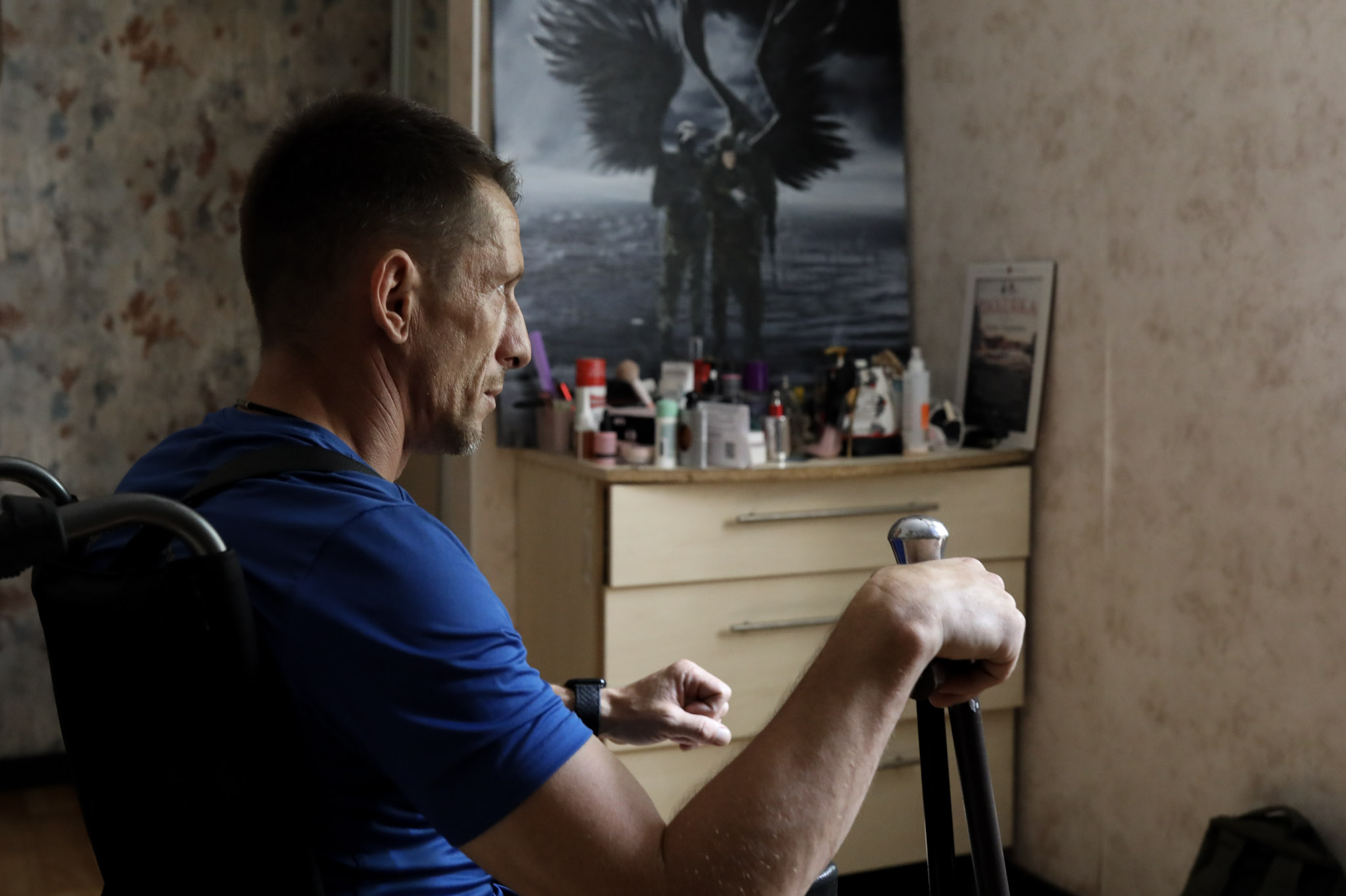
Leaning against a table in the bedroom is a huge painting depicting two angels with black wings holding a soldier by the shoulders and leading him across an open field riddled with potholes, from which thin wisps of smoke rise. Denis looks at it and gulps. It’s a scene from a dream he had while he was on the front lines.
At night, when he can’t sleep or when he wakes up suddenly, he makes himself a cup of coffee and waits for sunrise in his wheelchair, glancing now at the painting, now out the window. There are nights when his body continues to follow the schedule from the front lines. He wakes up at certain times because, he says, they used to receive assignments at those same times, and many of them had to be carried out in the dead of night.
It’s almost impossible to spend an entire day at home, Denis recounts. For that to happen, he’d have to turn off his phone. Except that now he’s doing exactly the opposite—he’s responding to everyone. “What if it’s a sponsor?”
But “I wasn’t always like this,” he admits. After he was injured, the phone was literally driving him crazy. It kept ringing, and people who didn’t know what else to say to him kept repeating the same two words: “Hang in there! Hang in there!”
„Damn it, man, why do you keep telling me to hang in there? How to hang in there?” For a man who had boxed for years and had grown accustomed to relying on his strength, coming to terms with his own body—now without both legs—and the new life he had to learn to accept did not appeal to him at all.
Back then, he could afford to turn off his phone and disappear for a few days. Now, however, he says he tries to be available at all times. Perhaps precisely because he knows what the other side of the call looks like. And he also knows that the war doesn’t end when you leave your post.
The hardest moments, Denis says, aren’t always the ones spent under gunfire, drones, or artillery fire. There is fear there, but there is also adrenaline; the body is working, and the mind has a task to perform. The real challenge comes later.
“To see your comrades dead…,” says Denis, lowering his tearful eyes.
Or the phone might ring: “So-and-so has died.”
A few days later: “The other one died, too.”
And it can’t be fixed by a phone call, a prosthesis, a cold shower, or time spent in the gym. “You can’t make peace with the dead on command,” Denis remarks, sitting in his wheelchair, his prosthetic limbs beside him and the two black angels staring down from the painting on the table.
The phone rings again. His friends are urging him to hurry. “The important person” has already arrived at the beach. Denis adjusts his prosthesis again and puts on a cap that he proudly says is one of only five in existence. One belongs to him, and the other four, he claims, ended up with Volodymyr Zelenskyy, the president of Ukraine; Valerii Zalujnyi, former commander-in-chief of the Armed Forces of Ukraine and current Ukrainian ambassador to the United Kingdom; Kirilo Budanov, former head of Ukrainian military intelligence and currently head of the Office of the President; and Donald Trump, the president of the United States.
“Who would have thought,” he says, as if surprised himself by where he’s ended up.
Long before all that, he had been a poor kid from a neighbourhood in Odessa, with no money and no connections, who had learned to box not only because he liked it, but also because, in Odessa in the ’90s, you had to know how to defend yourself. Now, his fame is evident in the people who answer his calls, the doors that open for him, and the caps that, as he says with a laugh, only a few people in the country wear.
He leaves the house on crutches. The phone is ringing again.
— Denis, hurry up!
— I’m coming, I’m coming!
It’s only a few meters to the Citroën, but Denis covers the distance almost at a run, in that impossible way of his, with his crutches thrust forward and his prosthetic legs hurrying after them. He jumps into the car. In a few moments, the car is speeding through Odessa once again, to the beat of the song “We Never Return.”
***
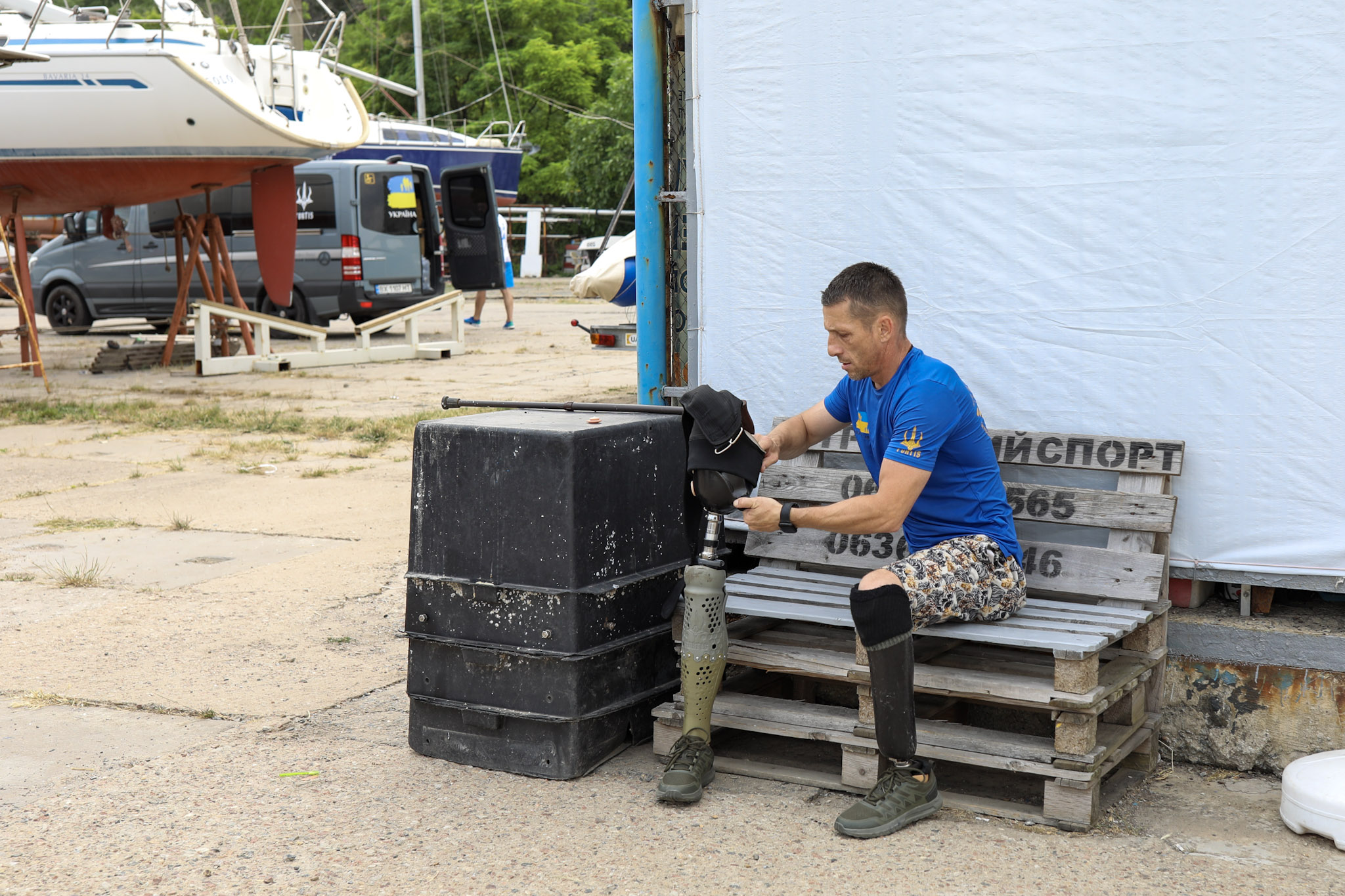
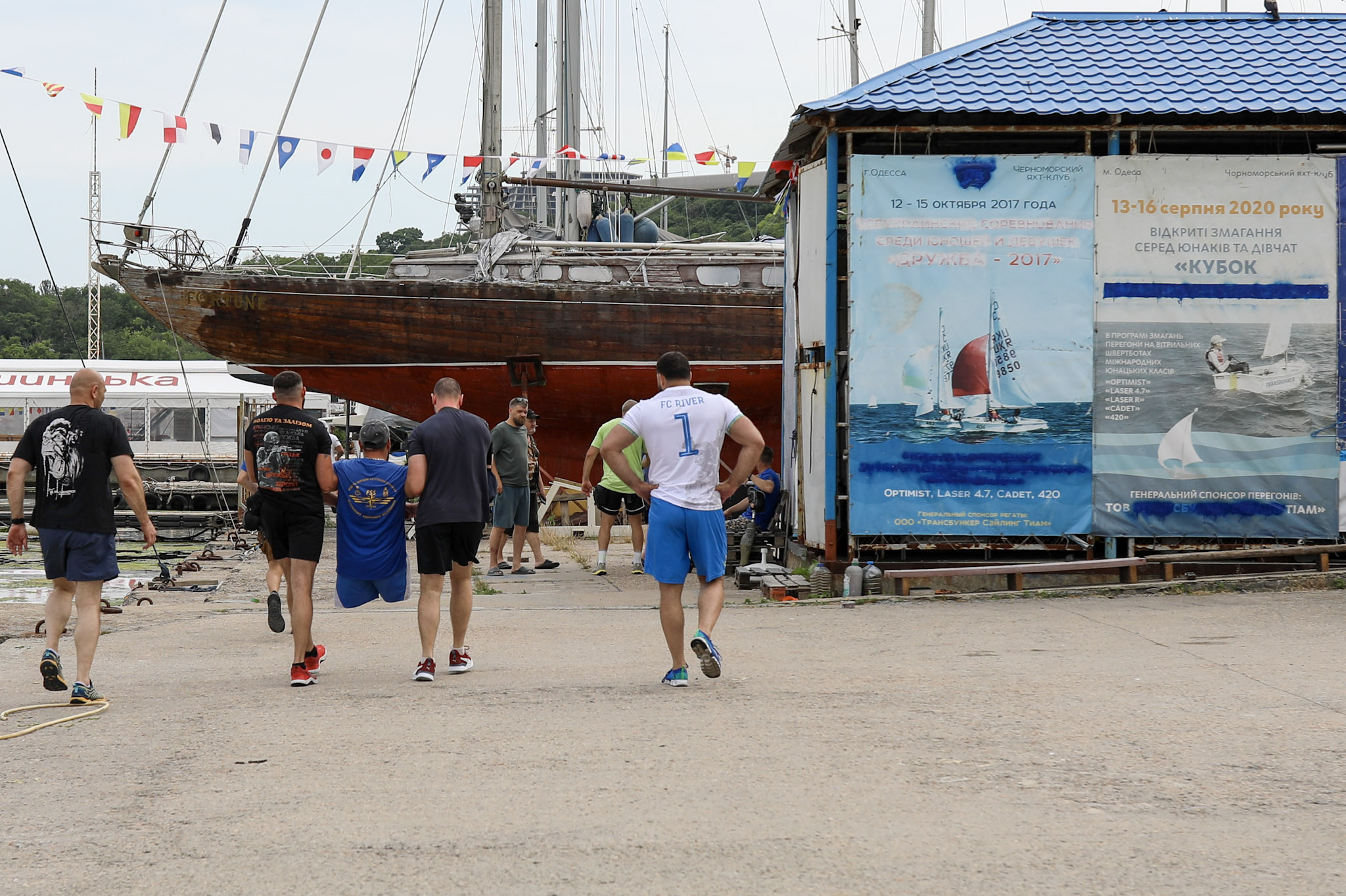
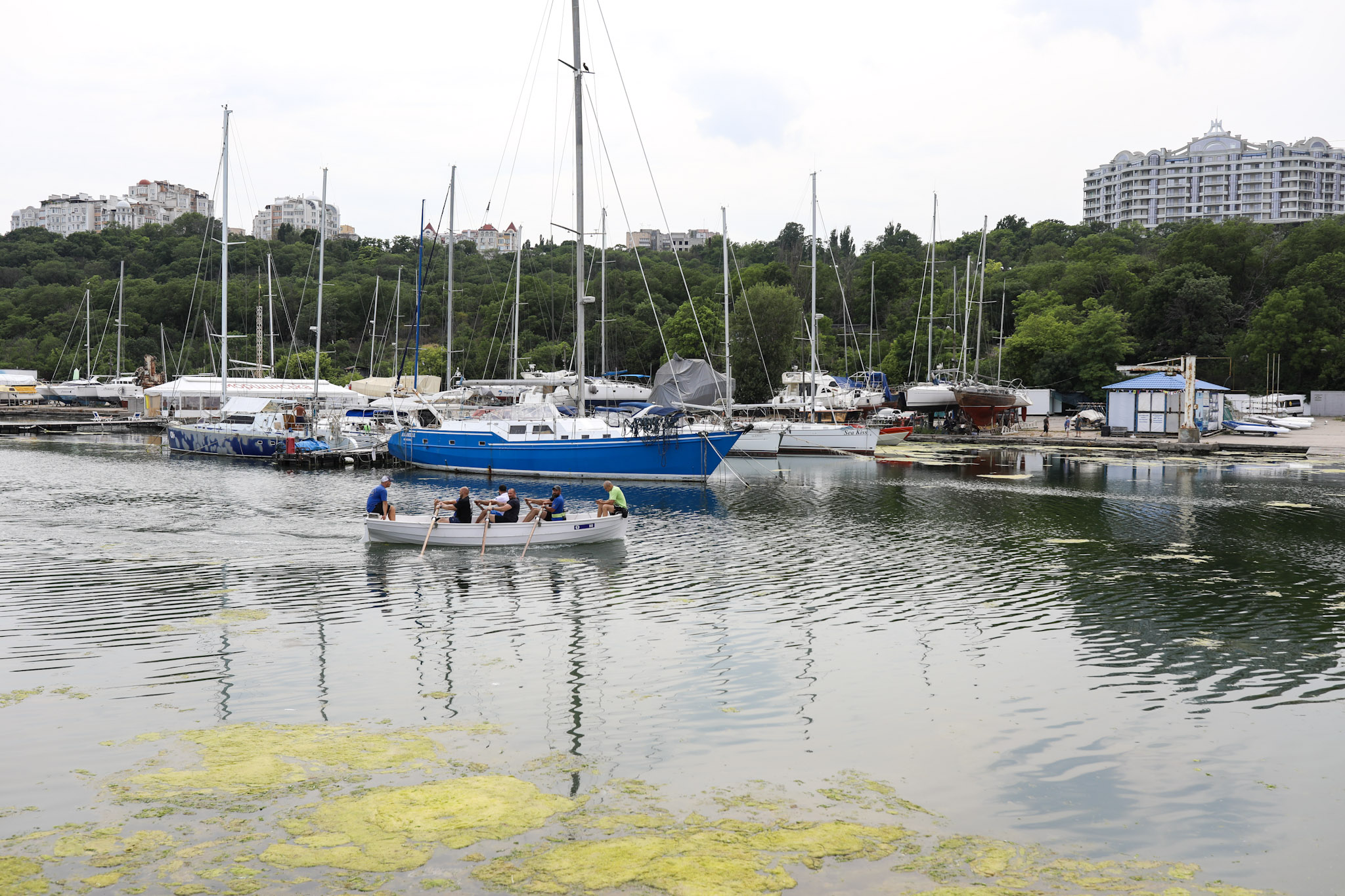
He parks the Citroën next to a few boats that have been pulled ashore. Beyond them lies the team’s training ground: a sort of harbour basin, protected from the open sea by a massive stone breakwater, where the waters of the Black Sea seem tamed. Inside, sailboats, yachts, and small boats are moored, tied side by side. Beyond the breakwater lies the open sea, but because of the war, they cannot go out to sea.
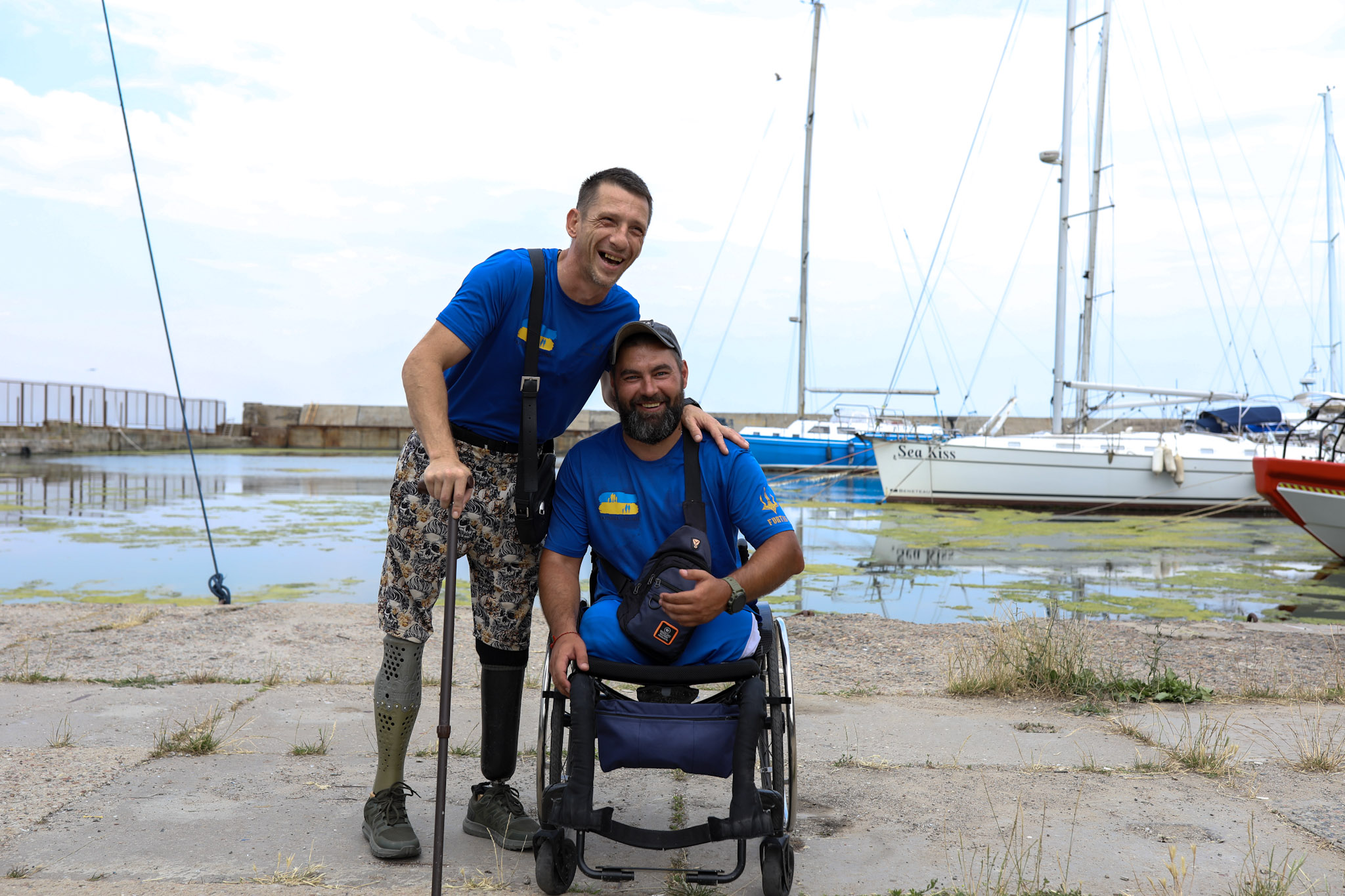
Under the hull of a boat that has been pulled ashore and raised about two meters off the ground, the veterans are already waiting for him, dressed in the team’s blue T-shirts. They’re sitting in chairs, talking and laughing. In front of them, a group of men dressed in black—as massive as wardrobes—form a circle around Serhii Lysak, the head of the Military Administration of the city of Odessa.
Joining them is Roman Terentiev, the acting head of the municipal agency responsible for physical education and sports. He is a man who is almost as burly, and whose maternal grandparents are from the village of Căplani, in the Ștefan Vodă district.
Denis sizes them up as he walks. To him, Lysak is not just the guest of honour today. He is the man who could open one of the doors Denis has been knocking on for months: funding for travel, equipment, and competitions.
If they manage to convince him to get in the boat, to feel with his own arms what it means to row, and maybe even to go with them to the championship in Kiev, half of the future speeches Denis would give in who-knows-what offices would become unnecessary.
The veterans stand up. The boat is taken out onto the water. Those who cannot climb on their own are carried up. One under the arms, another from the middle. The prostheses stay on the shore. Denis takes his off, too. He is picked up and placed in the boat right next to Lysak.
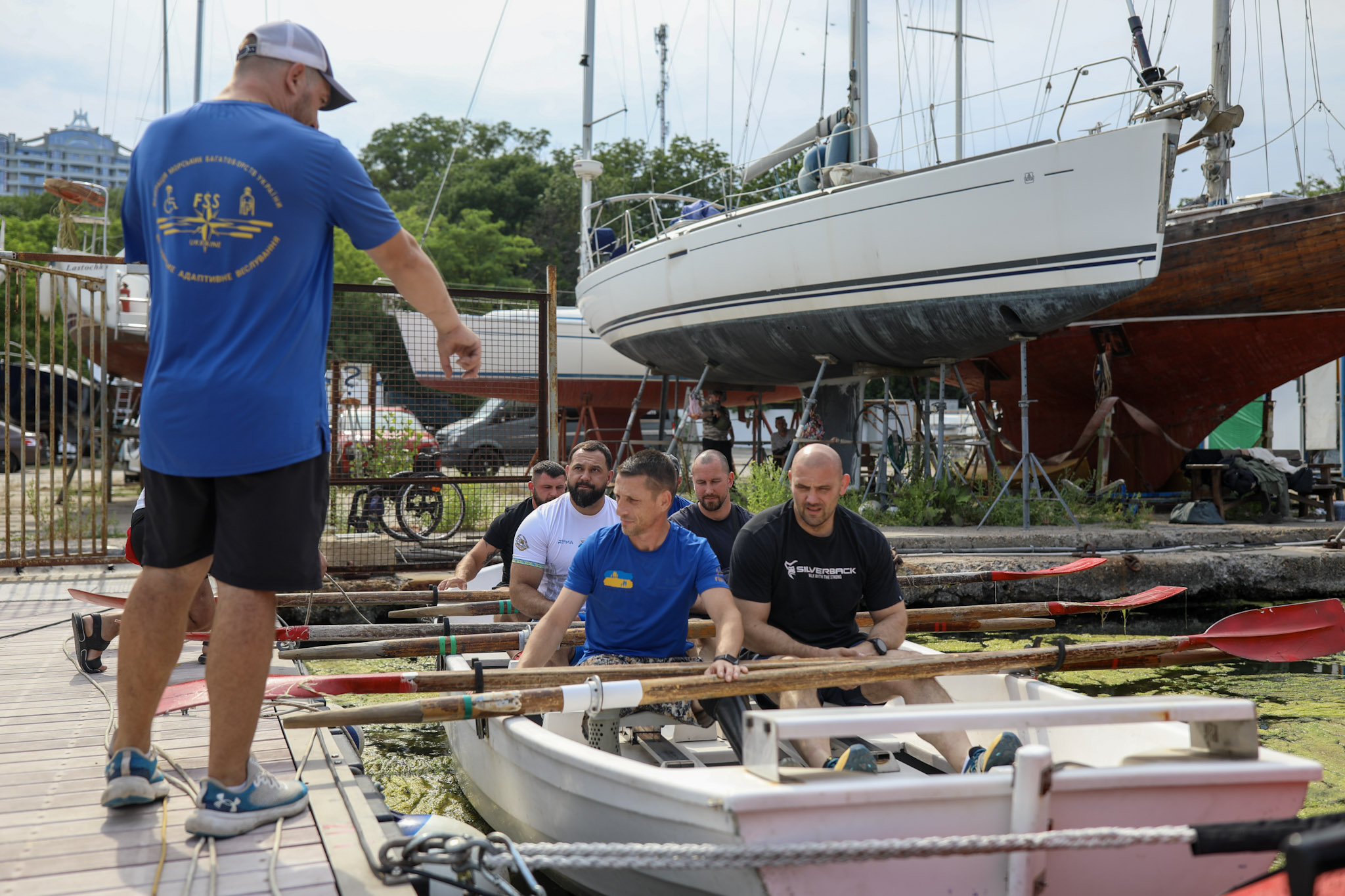
Coach Vitalii leans over them and begins to explain what they need to do. Lysak listens to him. On land, he may be a general, a former intelligence officer, or a military administrator. On the boat, none of those matters. Here, if you row poorly, the boat moves poorly. If you lose your pace, you’ll throw the rest of them off.
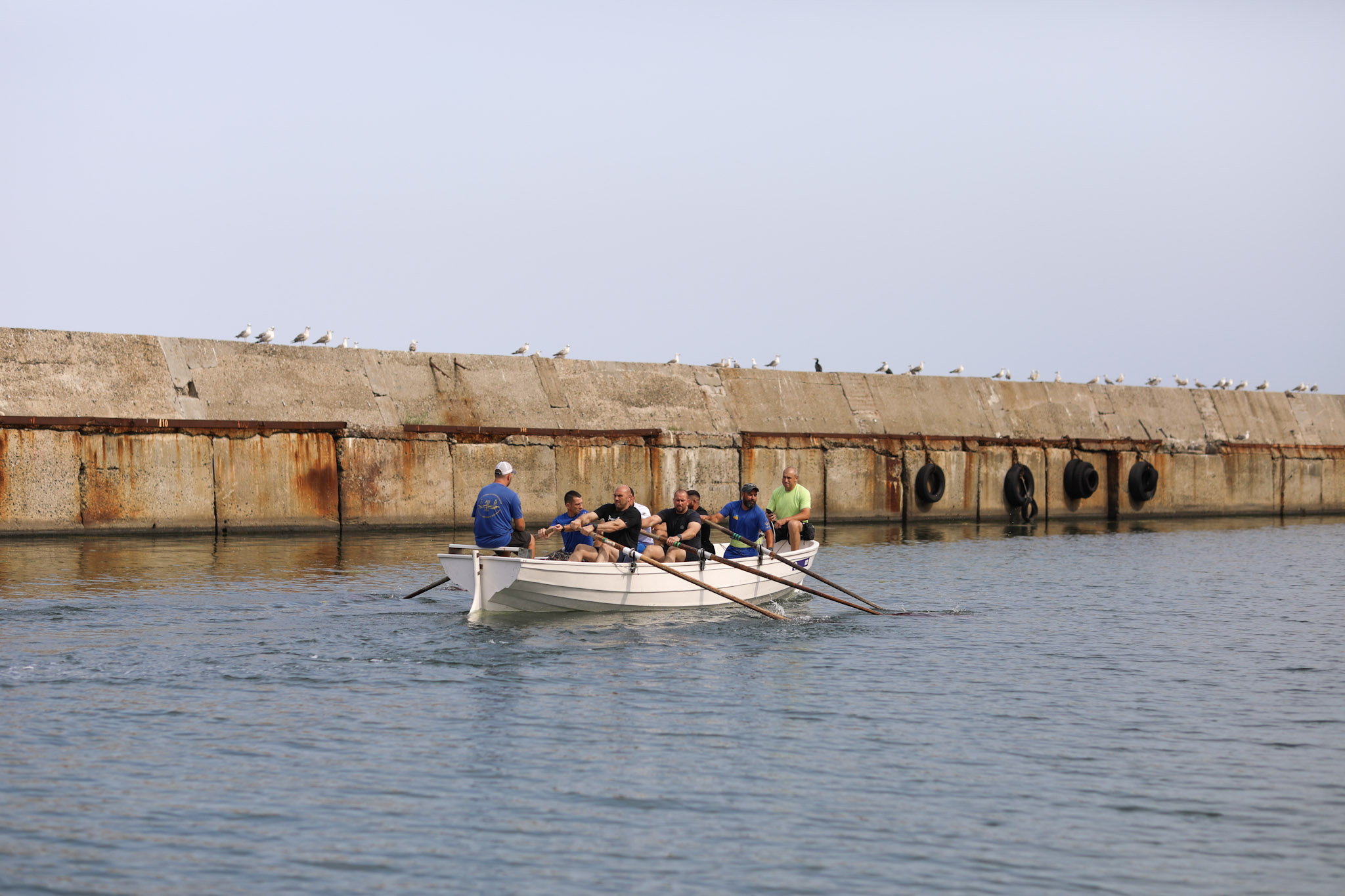
The boat slowly pulls away from the shore. At first, it moves carefully among the yachts and sailboats, making its way through the narrow channels of water. The oars dip into the water and emerge slowly, almost gently. Then the space opens up, and Dima sets the pace for them. The oars splash, and the whole boat seems to jolt. After a few minutes, breathing becomes laboured. Beads of sweat appear on their foreheads and trickle down their temples. The blue T-shirts cling to their backs.
On the beach just a few meters away, people are sunbathing. Everything looks so natural that, for a few moments, it seems as if the war has receded far away. But suddenly, the sky rumbles. The booms come from the sea, from afar, and then it seems as if they’re coming from everywhere. That’s the sound of drones being shot down by Ukrainian defences.
On the beach, people continue to sunbathe.
In the boat, no one lets go of the oars. Saltwater sprays from beneath the oars, while the ceaseless rumblings roll across the sea.
***
Suddenly, an explosion strikes so close by that the beams of the New York shelter shake. Dust falls on Denis, on Pasha, on the bodies of Donbas and Alabai. The fifth soldier on their team escaped unharmed, but he left them, taking with him the two radio sets, the spare batteries, the thermal imaging device, and some of the water.
Pasha is injured, too. Denis has both legs torn to shreds, he’s losing blood, and his fever is rising, but he can still move. He pulls Pasha inside, bandages his wounds, gives him some water to drink, and helps him relieve himself.
They still have food, but they only have one bottle of water left. Pain, says Denis, can be pushed into a corner of the mind. Thirst—no. Dehydration seemed more excruciating to him than the pain in his shattered leg. At some point, you no longer want salvation, family, or victory. All you want is to drink.
The days and nights are starting to blur together. They fall asleep or lose consciousness, and they no longer know where one ends and the other begins. The bodies of Donbas and Alabai are beginning to decompose, and rats are swarming. One day, Denis opens his eyes and sees that it’s five o’clock, but he can’t tell if it’s morning or evening.
— I think I’m dead, he says to Pasha through his chapped lips.
— I think so too, he replies in a barely audible whisper.
To keep from losing their minds, they speak whenever they can muster the strength. Pasha tells him about his farm in the Kherson region and promises Denis a piece of land where he can grow whatever he wants after the war.
Denis’s right leg is turning black, and his left foot is swelling. Pasha, barely moving, asks for the machine gun, even though he can no longer fight. If the Russians come, they have to shoot. And the Russians are trying to get closer.
Denis can’t see them. He can hear them about thirty meters away. He throws grenades without seeing his target and fires at the voices. Lying between the two dead bodies, he single-handedly fends off several attempts to approach him.
On the day they were supposed to be replaced, they hear the Ukrainian unit approaching the neighbouring position, Rome. They hear the injured being evacuated and a new group entering the area.
No one is coming to New York. That’s when they realize: as far as the brigade is concerned, they are already dead, and the position is considered lost. They will find out the explanation later—the soldier on their team who escaped unharmed and left them behind did not report that Denis and Pasha had been wounded but were still alive.
After a few more days of fever and delirium, Denis begins to talk to Alabai and Donbas. He knows they are dead—only their bodies are lying next to him—and yet he can hear their voices.
One night he dreams that he is standing on both feet again, and two scarred warriors, clad in armour and with wings, are heading toward him: “What’s up, brother? We’ve come for you.” One of them picks him up, covers his eyes, and lifts him high above the field. Denis asks him to take his hand away. Amid the wisps of smoke, he sees the shattered earth, the burned-out buildings, and New York below him.
Thirst is driving them mad, and the wait is becoming harder to bear than the pain. Not knowing if anyone else is coming. If you have one more day or one more hour. “That’s worse than being tortured.”
Around the tenth day, Denis has an idea: to kill himself. But not out of desperation. He wants to make his own death a final message to the living. The plan is for him to crawl outside first, to a visible spot. Maybe a Ukrainian drone will spot his body or his uniform, and that’s how they’ll find Pasha.
On the 11th day, he falls asleep before putting his plan into action.
Pasha pokes him.
— Hey, Jew. They hear voices behind the curtain.
A rustling sound. Steps. The voices are getting closer.
— Assholes! Surrender!
Denis responds almost instinctively:
— You are assholes! We won’t surrender!
It took them a few seconds—which felt like an eternity—to realize that the people outside were actually Ukrainian soldiers who had come to retake New York, convinced that the position had fallen into Russian hands.
A voice, strained and weak, can be heard from the bunker:
— Glory to Ukraine!
The curtain is drawn aside, and light floods into New York. Denis begins to cry.
***
He was supposed to stay for no more than five days to defend New York. He held out for 11, and was carried out on the shoulders of his comrades, who—having come with the intention of recapturing the position—found there two men who had refused to die.
Those 11 days cost him both legs, but they also marked a small advance of the front line in Ukraine’s favour. But he’ll find that out later. Ahead of him lay months in the hospital, trips from one doctor to another, and dozens of surgeries. And somewhere between that open field and the hospital’s last ward, Denis made a vow.
He swore he would live!
“I just asked God to save me. “So what was the point of asking Him, if I was going to take my own life afterward?”
That phrase stayed with him, and over time, it became one of the messages he conveys to soldiers returning from the front when they no longer see any reason to go on living.
One day, he received a call from the wife of a man who had lost both his arms and legs and for whom death seemed the only way out. The woman had heard about Denis from other veterans: that he had survived 11 days with his legs crushed; that, after his amputations, he had not only carried on with his life but had also taken up sports again and was competing; that he was helping other veterans and working with them to build a rehabilitation centre; and, perhaps most importantly for the woman who no longer knew whom to turn to for help, that he had managed to convince others in similar situations to step back from the brink.
“He told me then: ‘I can’t even wipe my own bottom. I can’t drink a cup of water without asking for help. What’s the point of living anymore?’” Denis recounts.
He no longer remembers word for word what he replied, but he does recall that he drew inspiration from the vow he had made to himself: if the man had made it to the hospital bed alive, it meant that when he had been wounded and death was upon him, he had desperately wanted to live.
“And I told him, ‘If you wanted to live, then please, just live. Since you made it all the way to the hospital, that means you wanted to live. Otherwise, you would have killed yourself before getting here… There is meaning. Even without hands, even without feet—you just build it yourself, exactly the way you want it’.”
He lifts his chin and points to a man in his fifties, with prosthetics on all four limbs, who is going about his business on the grounds of the veterans’ centre on the coast. “Do you see him? That’s him. I spoke with him on the phone. He’s now the site manager at the centre.”
Denis looks at him with a pride he doesn’t even try to hide. The man who, at that time, saw no reason to go on living now has people working under him, makes decisions, and works. And lives.
Of all the things Denis eagerly boasts about—championships, important people who answer his calls, doors he manages to open—this seems to be one of the few things that make his voice change: he doesn’t just want people to say that Denis the Jew was someone, but that, by passing through the lives of others, he left something good behind.
Just one day earlier, a surgeon from Odessa had called him. There was a soldier in the hospital who, likewise, no longer wanted to live. He saved him, too. Another person, another wound, but the same edge of the abyss toward which Denis himself had once crawled in New York—and from which he is now trying to pull others away.
The war took his legs, but it seemed to shift the centre of his life outside of himself. And the vow he made somewhere between New York and the last hospital ward is still holding true.
***
The booms can no longer be heard. With his face glistening with sweat, Denis rows alongside Serhii Lysak. The sun shines down on their tense faces, the water splashes rhythmically beneath their shovels, and Denis seems, for a few moments, simply happy.
Happy with the sea, with the people around him, with the body he has learned to use again, with this life that no longer resembles the one he had once imagined, but which he has learned to shape according to its new boundaries.
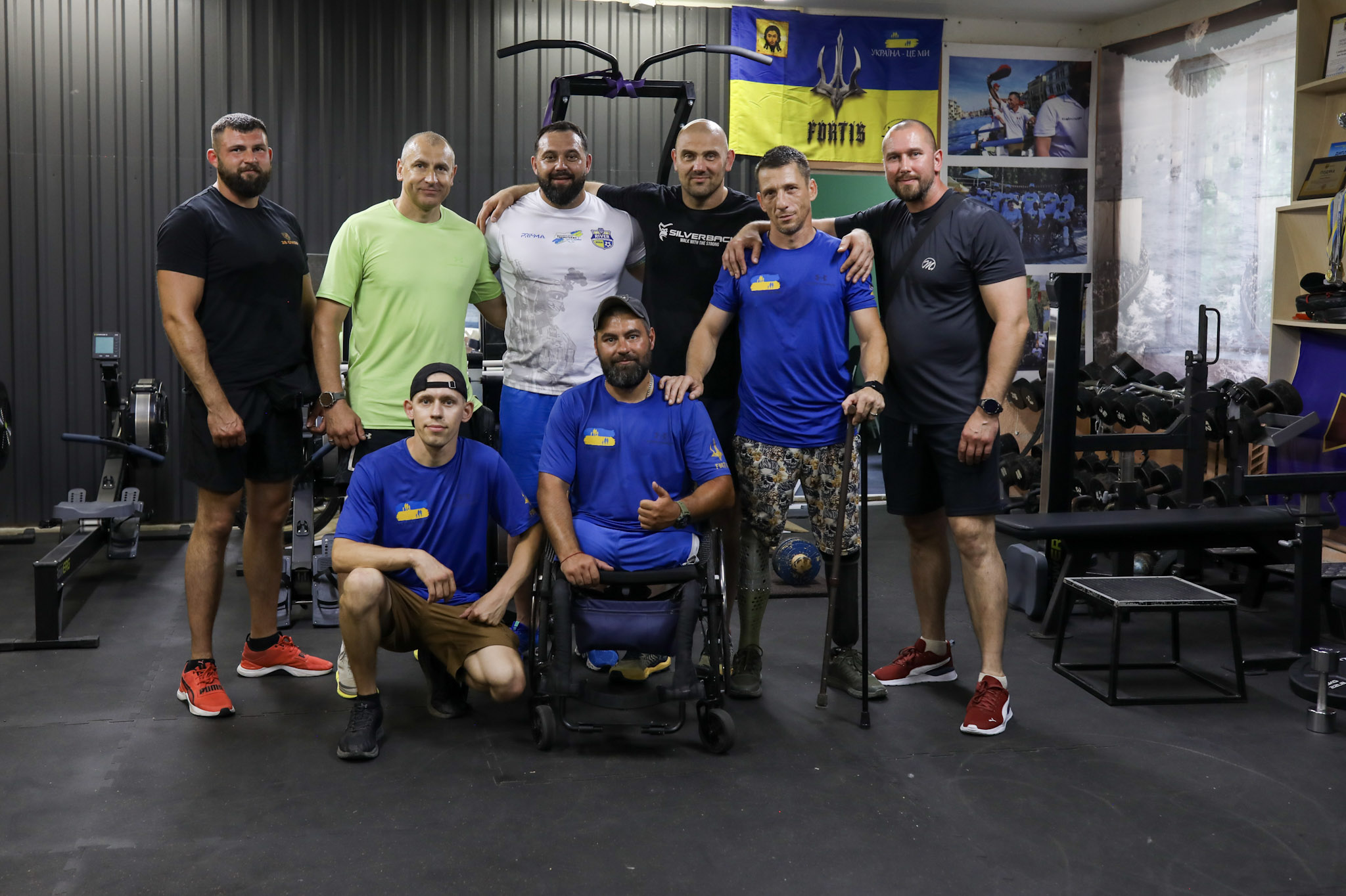
Two weeks later, at the championships in Kyiv, the oars bite into the water once more. Odesa’s yellow-and-blue boat lurches forward. Denis pulls. Jenia pulls. So do Serhii Lysak and Roman Terentiev. The sun falls on their faces, taut with effort and slick with sweat. Their blue Under Armour shirts stretch across their backs as their bodies bend and straighten in the same rhythm.
On the sea, as the booms of explosions rolled overhead, splitting and shredding the sky, Denis had persuaded them to take up the oars. Now, at last, he has them in the same boat at the championships, too. And they all pull at their oars in unison.
Denis grips the handle of his oar in his broad hands and drives the blade into the blue water with all his strength. There are only a few dozen metres to go, and the other boats are far behind. He looks triumphantly towards the finish line, where gold awaits them. Denis will make good on his promise to the people at Under Armour. The promise he made to himself, to live, he is already keeping.
Special thanks to Tetiana Bodnar for her assistance in producing this story.